
If you’ve spent any time on investing forums or scrolled through financial content online recently, you’ve probably seen someone talking about MSTY, TSLY, or NVDY — all part of the YieldMax family. The numbers get your attention fast. A 100% distribution rate. Weekly payouts. Yields that make your standard S&P 500 dividend fund look like it’s barely trying.
But here’s the thing: YieldMax ETFs work very differently from what most income investors expect. The mechanics behind these funds are genuinely interesting — and the risks are genuinely important. Whether you’re already holding one of these funds or just doing your research, this guide gives you the complete picture.
What Are YieldMax ETFs and How Do They Actually Generate Income?
YieldMax ETFs are actively managed, options-based exchange-traded funds that generate income by selling call options on individual high-volatility stocks or indices. Instead of holding shares of Tesla, Nvidia, or Coinbase directly, these funds use a synthetic covered call strategy to collect option premiums and distribute that income to shareholders — typically on a weekly or monthly basis.
<cite index=”45-1″>The basic engine works like this: the fund creates a synthetic long position using options contracts to mimic owning the underlying stock, then sells call options on that synthetic position to collect premiums. Those premiums, along with any other income, get paid out to shareholders as distributions.</cite>
<cite index=”47-1″>Take NVDY (the YieldMax NVDA Option Income Strategy ETF) as an example. It generates income while providing exposure to Nvidia’s price returns, subject to a cap on potential gains. The strategy combines three elements: synthetic long exposure to Nvidia’s price movements (achieved through at-the-money calls and puts), covered call writing to generate premium income, and U.S. Treasury securities held as collateral.</cite>
The Synthetic Covered Call Strategy, Simplified
Most people understand a traditional covered call: you own shares of a stock and sell someone else the right to buy them at a fixed price in exchange for a cash premium. YieldMax takes that concept and applies it synthetically — meaning they don’t actually own the shares of Tesla or Nvidia. They replicate the exposure using options contracts, which frees up capital that gets invested in U.S. Treasuries as collateral and generates additional interest income.
<cite index=”46-1″>The call options sold by these funds generally have strike prices set approximately 0–15% above the current share price of the underlying security. This creates a position that generates income from option premiums yet caps potential gains if the underlying stock rises significantly beyond that strike price.</cite>
This cap is one of the most important things to understand before investing. If Tesla doubles, TSLY won’t capture that full move. You’re trading upside participation for current income. 247wallst.com
What Backs the Distributions?
<cite index=”30-1″>YieldMax actively managed ETFs like TSLY are designed to generate weekly income by selling call spreads on the underlying stock, systematically harvesting option premiums from the stock’s volatility and striving to turn that volatility into a regular income stream.</cite> The higher a stock’s implied volatility, the larger the premiums the fund can collect — which is why YieldMax tends to target notoriously volatile names like Tesla, MicroStrategy, and Coinbase.
A Look at the Most Popular YieldMax Funds Right Now
Here’s a current snapshot of the most widely held YieldMax ETFs as of late September 2026:
| ETF Ticker | Underlying Asset | Distribution Rate* | Return of Capital (Recent)* | Distribution Frequency |
|---|---|---|---|---|
| TSLY | Tesla (TSLA) | See fund page | 0.04% | Weekly |
| NVDY | Nvidia (NVDA) | 40.51% | 8.25% | Weekly |
| MSTY | MicroStrategy (MSTR) | 100.32% | 97.70% | Weekly |
| CONY | Coinbase (COIN) | See fund page | 96.63% | Weekly |
| YMAX | Fund of YieldMax ETFs | See fund page | Varies | Weekly |
| YMAG | Magnificent 7 stocks | See fund page | Varies | Weekly |
As of September 23–24, 2026. Source: yieldmaxetfs.com. Distribution rates and return of capital percentages change weekly and are not guaranteed.
<cite index=”53-1″>YieldMax announced its most recent Group 2 weekly distributions on September 23, 2026, with an ex-date of September 24 and a payment date of September 25, 2026.</cite>
YMAX is the umbrella option. <cite index=”44-1″>YMAX operates as a “fund of funds,” primarily investing in other YieldMax ETFs rather than directly in individual company securities. Each underlying ETF employs synthetic covered call strategies on specific securities or indices to generate income through option premiums — creating multiple layers of complexity for investors.
The Yield Numbers Look Incredible. Here’s Why You Need to Look Closer.
This is where things get real. A 100% distribution rate on MSTY sounds extraordinary until you understand what’s actually happening inside the fund’s distributions.
Return of Capital: The Number Most Investors Miss
<cite index=”51-1″>As of September 23, 2026, MSTY’s most recent distribution contained an estimated 97.70% return of capital and just 2.30% income.</cite> Similarly, <cite index=”49-1″>CONY’s most recent distribution as of the same date contained approximately 96.63% estimated return of capital and only 3.37% income.</cite>
That’s not a typo. When a fund’s distribution consists almost entirely of return of capital (ROC), it means the fund is largely handing your own money back to you, not generating new income from its options strategy. <cite index=”48-1″>Covered call ETFs are marketed as generating payouts from option premiums. But in practice, many funds also rely heavily on return of capital — meaning part of the “distribution” is just your own money being handed back to you to make the yield look bigger. Return of capital in practice works a lot like a reverse mortgage: you receive steady payments, but the underlying asset slowly deteriorates.</cite>
NAV Erosion: The Silent Risk
When a fund consistently pays out more than it earns from premiums, the fund’s Net Asset Value (NAV) declines over time. Lower NAV means each share is worth less — and lower future distributions (since distribution rates are calculated off the current NAV). <cite index=”39-1″>YMAX’s high starting yield (approximately 46%) has been undermined by severe NAV erosion, with distributions falling by roughly 52.9% since October 2025. The fund’s synthetic option strategy structurally limits upside, fails to protect against downside, and underperforms market indices and high-yield alternatives.</cite>
Capped Upside With Full Downside Exposure
Here’s the asymmetry that stings the most: YieldMax funds cap your gains when the underlying stock rallies sharply, but they don’t protect you when it falls hard. <cite index=”44-1″>Because the underlying ETFs maintain full exposure to the downside of their reference securities, significant market corrections can lead to substantial NAV erosion that the option premium income may not offset.</cite>
You’re not hedged. You’re capped on the upside and fully exposed on the downside — with income payments that may or may not cover the losses.
YieldMax ETFs vs. Traditional Dividend Stocks: An Honest Comparison
| Feature | YieldMax ETFs | Traditional Dividend Stocks |
|---|---|---|
| Distribution frequency | Weekly or monthly | Quarterly (most) |
| Typical yield | 20%–100%+ | 1%–5% |
| Upside participation | Capped | Full |
| Downside protection | None | None (but no structural erosion) |
| Income source | Option premiums + potential ROC | Company earnings/profits |
| Capital erosion risk | High (structural) | Low (market-driven only) |
| Tax treatment | Ordinary income + ROC | Qualified dividends (often lower rate) |
| Diversification | Single-stock exposure | Varies widely |
The most important distinction: when a traditional dividend stock’s share price falls, it’s because the market moved. When a YieldMax ETF’s NAV erodes, it can be a structural feature of the fund’s design — baked into how distributions are funded.
Who Are YieldMax ETFs Actually Designed For?
These funds aren’t for everyone. They aren’t even meant to be.
YieldMax ETFs are specifically built for income-focused investors who prioritize current cash flow over long-term capital growth. That might describe:
- Retirees drawing regular income from their portfolio who don’t need the underlying assets to appreciate
- Short-term income tacticians using these funds as part of a broader strategy with a defined time horizon
- Options-aware investors who understand the mechanics and are deliberately accepting capped upside in exchange for premium income
- Investors in volatile single-stock names who want exposure to something like Nvidia or Tesla but with a yield component built in
<cite index=”42-1″>The core appeal is real: investors accept NAV erosion as the cost of harvesting massive distributions, often comprising return of capital alongside option income. For context, PLTY’s trailing 12-month total return as of mid-2025 was approximately 123%, driven by synthetic covered call strategies on volatile stocks that rely on high implied volatility to generate premiums.</cite>
Who Should Think Carefully Before Buying
- Long-term buy-and-hold investors focused on total return — the capped upside and potential NAV decay work against compounding
- Investors who need capital preservation — these funds aren’t designed to protect principal
- Anyone who doesn’t understand options — the underlying mechanics matter more here than with most ETF categories
- Tax-sensitive investors — distributions are typically taxed as ordinary income, not at the lower qualified dividend rate
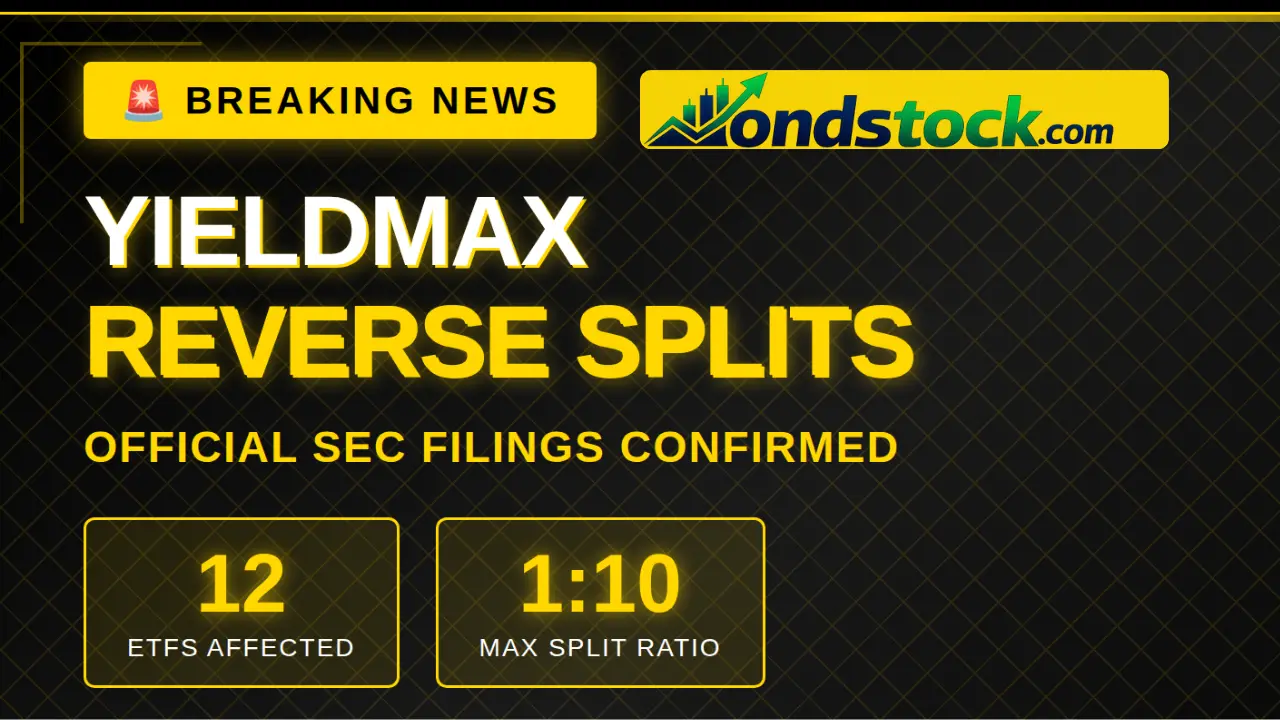
The 2025–2026 Reverse Split Situation
One important development that many investors don’t know about: <cite index=”48-1″>YieldMax conducted a massive reverse split across 15 of its products. The affected tickers include ABNY, AIYY, AMDY, CONY, CRSH, DIPS, FIAT, MRNY, MSTY, OARK, PYPY, TSLY, ULTY, XYZY, and YBIT.</cite> Reverse splits happen when a fund’s NAV erodes to the point where management consolidates shares to bring the price per share back up. This doesn’t change the total value of your position, but it is a signal worth paying attention to regarding long-term NAV trend.
Costs, Fees, and What You’re Actually Paying
<cite index=”57-1″>Most individual YieldMax ETFs carry a gross expense ratio of 0.99%. YMAX — the fund of funds — has a management fee of 0.29% plus acquired fund fees and expenses of 0.99%, for a total gross expense ratio of 1.28%. YMAG carries a gross expense ratio of 1.12%, and ULTY runs at 1.40% (with a net expense ratio of 1.30% after a fee waiver).</cite>
Those fees are meaningful, especially as NAVs decline over time. A 0.99% annual expense ratio on a shrinking asset base compounds the problem of capital erosion.
How to Think About YieldMax ETFs in a Portfolio
If you’re going to use these funds, the most practical approach is to treat them as a tactical income tool rather than a core holding. <cite index=”39-1″>Analysts have recommended reinvesting distributions from YMAX into growth or more tax-efficient income positions rather than compounding within YMAX itself, specifically to offset the capital erosion built into the fund’s structure.</cite>
A few practical guidelines worth considering:
- Limit position size. High-income, high-erosion funds work better as a slice of a portfolio than as a centerpiece.
- Track NAV, not just the distribution rate. A 90% yield on a fund that loses 70% of its NAV is not a good outcome.
- Understand what percentage of distributions is ROC. YieldMax publishes this data weekly on its website. Check it.
- Compare total return, not just income. The distribution rate is not total return. These are very different numbers.
- Match the fund to your time horizon. If you need this capital in three years, a structurally eroding vehicle may not be appropriate.
Final Assessment: Are YieldMax ETFs Worth It?
YieldMax ETFs do exactly what they say they do. They generate income — sometimes extraordinary amounts of it — by harvesting option premiums on some of the most volatile stocks in the market. That’s real. The income is real. The distributions hit your account.
The question is whether you understand what you’re actually getting. When MSTY’s distribution is 97.70% return of capital, you’re not earning yield in any traditional sense — you’re being paid back your own money in installments while the fund’s value declines. That might still fit your strategy. Or it might not.
The investors who use these funds well are the ones who go in with clear expectations: defined time horizons, realistic total-return math, and a genuine understanding of how synthetic covered call strategies behave in different market environments. The investors who struggle are the ones who see a 100% yield and treat it like a bond.
YieldMax ETFs are a legitimate, sophisticated tool. Used correctly, they solve a real problem for income-focused investors. Used carelessly, they’re an expensive lesson in the difference between distribution rate and total return.
Frequently Asked Questions
What is YieldMax’s blog post today?
YieldMax posts weekly distribution announcements on yieldmaxetfs.com and via Globe Newswire. The most recent Group 2 announcement was September 23, 2026.
What are people saying about YieldMax on Reddit?
Discussions on r/ETFs and r/dividends are mixed — income investors defend the high yields while total-return investors flag NAV erosion and return of capital as serious concerns.
What is the latest YieldMax news today?
As of September 26, 2026, MSTY’s distribution rate is 100.32% (97.70% return of capital) and NVDY’s is 40.51%. The next Group 1 announcement is scheduled for September 29, 2026.
Can you buy YieldMax ETFs on Robinhood?
Yes. YieldMax ETFs trade on major U.S. exchanges and are available on Robinhood, Fidelity, Schwab, and most other retail brokerages.
When does YieldMax announce its distributions?
Group 1 is announced every Tuesday (ex-date Wednesday, paid Thursday). Group 2 is announced every Wednesday (ex-date Thursday, paid Friday). Announcements go out via Globe Newswire and yieldmaxetfs.com.
Has YieldMax done any reverse splits recently?
Yes. YieldMax reverse-split 15 ETFs in 2025 — including TSLY, MSTY, CONY, and ULTY — after sustained NAV erosion drove share prices down significantly.
Also Read…