Verizon Dividend History
Verizon Communications (NYSE, Nasdaq: VZ) declared a quarterly dividend of 70.75 cents per share on September 9, 2026, the same rate as the prior quarter. It is payable on November 2, 2026, to shareholders of record on October 9, 2026. Verizon’s own count is 20 consecutive years of dividend increases.
This guide covers the full record, the dates that matter, and whether the payout looks sustainable. Figures are current as of September 21, 2026.
Verizon’s Dividend at a Glance
- Quarterly dividend: $0.7075 per share, which works out to $2.83 a year StockAnalysis
- Yield: about 5.88% as of September 18, 2026. Another tracker cited roughly 5.6% at a share price near $50. The gap is share-price timing. MacroTrendsYahoo Finance
- Cash cost: about $11.5 billion in dividends in 2025, across roughly 4.2 billion shares Nasdaq
- Cadence: four payments a year, not monthly
How Has Verizon’s Dividend Changed Since 2021?
Verizon’s dividend has grown slowly and predictably. From 2021 through 2025 the board added 1.25 cents a quarter each year. The 2026 raise was a little larger.
| Year | New quarterly dividend | Increase | Approx. % gain | Streak year |
|---|---|---|---|---|
| 2021 (Sept.) | $0.6400 | +1.25¢ | 2.0% | 15th |
| 2022 (Sept.) | $0.6525 | +1.25¢ | 2.0% | 16th |
| 2023 (Sept.) | $0.6650 | +1.25¢ | 1.9% | 17th |
| 2024 (Sept.) | $0.6775 | +1.25¢ | 1.9% | 18th |
| 2025 | $0.6900 | +1.25¢ | 1.8% | 19th |
| 2026 (early) | $0.7075 | +1.75¢ | 2.5% | 20th |
The 2021 through 2024 raises came in September, and each was 1.25 cents (2022, 2023 and 2024 followed the same pattern). Verizon then moved from $0.6775 to $0.69 in 2025, its 19th straight raise, and to $0.7075 in early 2026 for the 20th. The 2026 increase was reported as a 2.5% jump, declared in January. The December 2025 declaration was still at 69 cents, payable February 2, 2026, so the higher rate shows up in later payments.
My read: the quarterly payout rose about 10.5% between late 2021 and today, roughly 2% a year. That is dependable income, but it is not dividend growth in the sense that PepsiCo or Procter & Gamble investors expect. In 2023, critics noted that the 1.9% raise trailed inflation, which was running at 3.7% at the time.
One caution on the streak: some data sites show a higher count (Koyfin lists 22 years). Verizon’s own figure is 20, so use that.

Has Verizon Ever Cut Its Dividend?
No cut appears anywhere in the 20-year record. Each year in the table above ended higher than the last, and management has framed the payout as a top capital-allocation priority. The “cut” searches likely stem from AT&T, which reduced its own dividend in 2022 when it spun off WarnerMedia. Verizon did not follow, and its yearly raises continued.
When Does Verizon Pay Its Dividend?
Verizon pays quarterly, on the first business day of February, May, August and November. Declarations come roughly two months earlier.
| Payment | Record date | Pay date | Amount |
|---|---|---|---|
| Q1 2026 | Jan. 12 | Feb. 2 | $0.69 |
| Q3 2026 | July 10 | Aug. 3 | $0.7075 |
| Q4 2026 | Oct. 9 | Nov. 2 | $0.7075 |
Sources: the December 2025 declaration, the June 4, 2026 declaration and the September 9, 2026 declaration. A May payment also went out at the new rate.
Since U.S. markets moved to T+1 settlement, the ex-dividend date and record date are the same day. Data providers show the next ex-dividend date as October 9, 2026. To collect the November payment, own shares before that date. If the pattern holds, the next declaration should arrive in early December, but that is not confirmed. StockAnalysis
Is the Verizon Dividend Safe?
Short answer: it looks well covered by cash flow today, though the payout is large and the balance sheet is not light.
- Free cash flow: free cash flow was $10.2 billion in the first half of 2026, up 16%. Full-year growth guidance is 9% to 10%. By my estimate, first-half dividends were about $5.9 billion (4.2 billion shares × $0.7075 × two quarters), which is roughly 1.7 times coverage.
- Payout ratio: 2026 adjusted EPS guidance is $4.99 to $5.04. Against the $2.83 dividend, that is a payout ratio of about 56% to 57%. A third-party tracker puts 2025 free cash flow near $20.1 billion, which makes the $11.5 billion dividend roughly 57% of cash flow.
- Earnings quality: GAAP EPS fell 22% to $0.92 in the second quarter, while adjusted EPS rose 6.6% to $1.30. Cash flow and adjusted earnings are the better guides here, but watch the gap.
- Debt: Verizon still carries a meaningful amount of debt, though net unsecured debt declined in the second quarter. Higher interest rates and refinancing costs would squeeze cash available for shareholders.
- Recent track record: management said that over the past five years average annual free cash flow and adjusted EPS grew at roughly negative 1%. The dividend rose while earnings stood still, so the payout ratio drifted up. The 2026 rebound is what makes the ratio look healthier now. Investing.com
Dividend safety depends on that recovery holding. Wireless competition, heavy network spending and the Frontier integration are the main sector-specific risks. Operating income fell 3% in the December 2025 quarter as the Frontier acquisition and a January network outage weighed on results.
What Might the Dividend Look Like in 2026–2028?
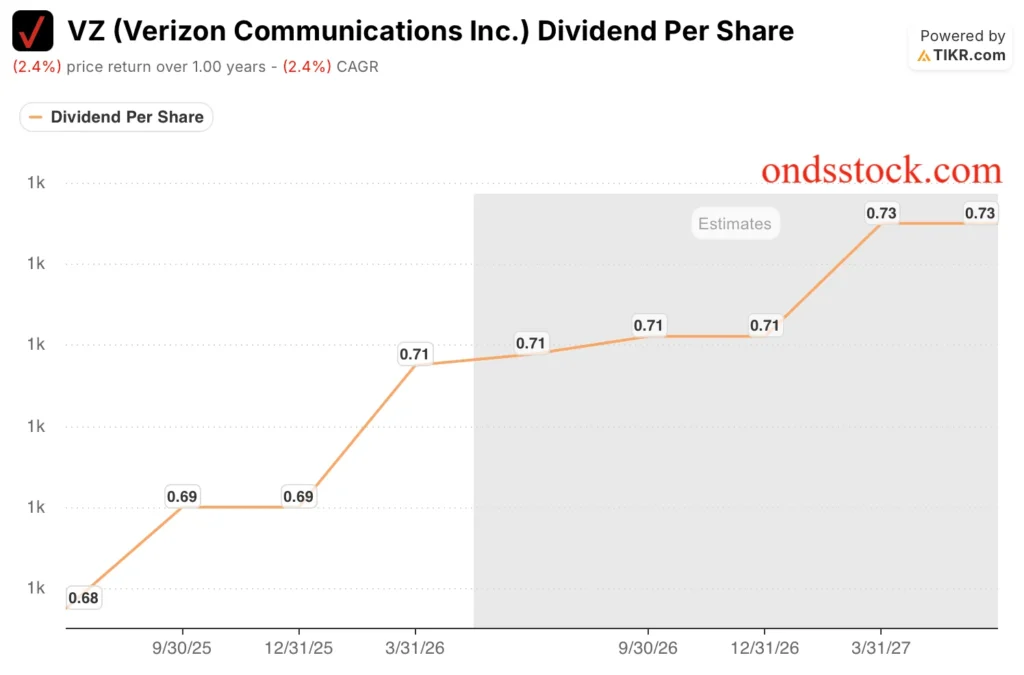
Verizon has not announced another increase. Model-based estimates from TIKR point to low-single-digit dividend growth, near 3% in late 2026 and easing toward 2% by mid-2027.
For context, here is my own illustrative scenario, not guidance. If Verizon keeps adding 1.25 to 1.75 cents a year:
- Next raise: quarterly payout of about $0.72 to $0.725, or $2.88 to $2.90 a year
- Following year: about $0.7325 to $0.7425, or $2.93 to $2.97 a year
Stronger cash flow could support bigger steps, but management’s pattern favors modest, dependable ones.
What Is Verizon’s Shareholder Yield?
Shareholder yield adds buybacks to dividends. Verizon returned $9.4 billion to shareholders in the first half of 2026 and raised its full-year buyback target to up to $4.5 billion.
My rough math: about $11.8 billion in 2026 dividends plus up to $4.5 billion in buybacks is roughly $16 billion. Against a market cap of about $205 billion (4.2 billion shares at $48 to $50), that is a shareholder yield near 8%. Buybacks are discretionary, so the dividend is the sturdier part.
How Does Verizon Compare With Other Dividend Stocks?
Verizon sits in the high-yield, low-growth corner of large-cap income investing. Consumer staples and healthcare names such as PepsiCo, Procter & Gamble, Coca-Cola and Johnson & Johnson, along with Exxon Mobil, generally offer lower starting yields but far longer raise streaks. Verizon is still about five years short of Dividend Aristocrat status, which requires 25 consecutive annual increases. Realty Income, a REIT that pays monthly, is a closer comparison on yield and growth pace.
I did not pull current yields for those peers, so compare live numbers before deciding. Telecom cash flows are steady and recurring, but debt and capital requirements are heavier than in most consumer businesses.
The Bottom Line for Income Investors
Verizon offers a yield near 6%, a 20-year raise streak and improving free cash flow. It does not offer fast dividend growth. It suits investors who want dependable current income and can accept modest capital appreciation. This is general information, not personalized investment advice.
Fequently Asked Questions
Where can I find a Verizon dividend history chart?
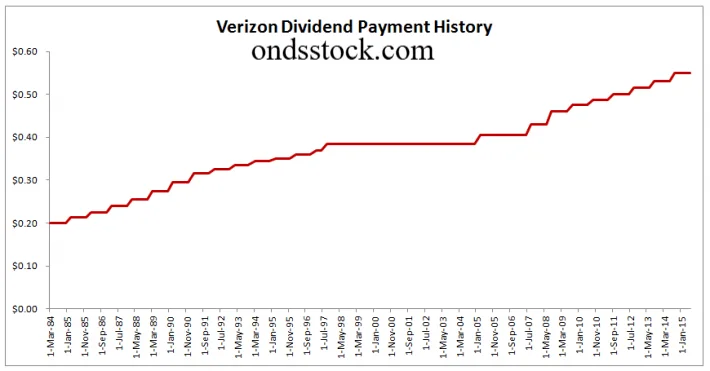
Plotted over time, the dividend looks like a gentle staircase: flat for most quarters, then a small step up once a year. MacroTrends offers historical dividend payout and yield charts going back to 1986. Verizon’s investor relations site and Nasdaq also publish full payout tables.
What was Verizon’s dividend history in 2023?
Verizon paid 65.25 cents per quarter through the first three payments, then raised it by 1.25 cents to 66.50 cents on September 7, 2023, payable November 1. That was the 17th straight annual increase, so 2023 payments totaled about $2.62 per share.
Has Verizon ever cut its dividend?
No cut appears in Verizon’s current record of 20 consecutive years of increases. Confusion often comes from AT&T’s 2022 cut, which was a separate company decision.
What are the VZ dividend dates for 2026?
Payments were on February 2 (record January 12) and August 3 (record July 10). The next is November 2, 2026, for holders of record on October 9.
What is the Verizon dividend in 2026?
Shareholders received $0.69 in February and $0.7075 for the remaining 2026 payments, about $2.81 for the year. The annualized rate is $2.83.
When was the last Verizon dividend increase?
The latest raise came in early 2026, from $0.69 to $0.7075, extending the streak to 20 years. The September 2026 declaration held the rate steady, and no next increase has been announced.
What was Verizon’s dividend history in 2021?
The quarterly dividend was 62.75 cents until September 2, 2021, when the board raised it by 1.25 cents to 64 cents, payable November 1, 2021. That was the 15th consecutive annual increase
Also Read…