

Best Monthly Dividend Stocks Under $20. That works fine on paper, but it doesn’t always line up with how expenses actually hit your bank account. Monthly dividend stocks solve that problem directly — and the best ones under $20 per share make it easy to build a position without tying up significant capital.
The options in this category cover several distinct income strategies: REITs that collect rent from industrial or commercial properties, mortgage REITs that earn on interest spreads, and business development companies (BDCs) that lend to growing businesses. Each structure carries a different risk profile and yield level, which means the right pick depends heavily on what you actually need from an income investment.
This guide covers the strongest monthly dividend stocks trading under $20 as of September 2026, with current yield data, what drives each payout, and honest notes on the risks involved.
What Makes a Monthly Dividend Stock Worth Owning Under $20?
The short answer: A lower share price doesn’t say anything about quality on its own. What matters is whether the business generates enough cash flow to sustain the dividend — and whether the underlying assets hold their value over time.
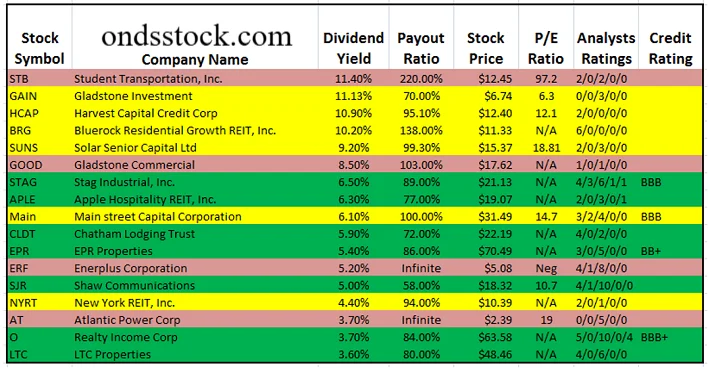
Several genuine income categories trade below $20 per share right now. Mortgage REITs are the most common, because they operate with high leverage and pay out the spread between borrowing costs and mortgage interest. BDCs lend to small and mid-sized businesses at floating rates, making them sensitive to interest rate cycles. Industrial and net-lease REITs are generally safer on dividend coverage but tend to trade at higher prices — which is actually worth noting: stocks like Realty Income (NYSE: O) and STAG Industrial (NYSE: STAG) have climbed well above $20, putting them outside the under-$20 filter even though they’re strong businesses. The options below are stocks that still fall inside the price range.
Before buying, always verify:
- Dividend coverage — Is the payout supported by earnings, cash flow, or net interest income?
- Payout history — Has the dividend been cut before?
- Balance sheet quality — How much leverage does the company carry?
- NAV trend — Is book value growing, flat, or eroding?
With that in mind, here are the top picks.
Best Monthly Dividend Stocks Under $20 Right Now

1. AGNC Investment Corp (NASDAQ: AGNC) — ~$10 | ~14.3% Yield
AGNC is the largest agency mortgage REIT in the US, and it’s one of the most recognizable names in the high-yield monthly dividend space. <cite index=”71-1″>The current trailing twelve-month dividend payout for AGNC as of September 15, 2026 is $1.44 per share, producing a yield of approximately 14.27%.</cite> The monthly rate is $0.12 per share — a level AGNC has maintained consistently since January 2020.
The key distinction with AGNC is that its portfolio consists entirely of agency-backed mortgage securities — instruments guaranteed by the US government or government-sponsored entities like Fannie Mae and Freddie Mac. That removes credit risk from the equation but leaves significant interest rate risk in place. When spreads between short-term borrowing costs and long-term mortgage yields widen, AGNC performs well. When they compress, book value suffers.
<cite index=”64-1″>AGNC’s tangible net book value declined 5.6% in Q1 2026, reflecting spread widening driven by geopolitical volatility in the Middle East. However, full-year 2025 Economic ROTCE came in at 22.7%, showing the underlying income engine has real strength in the right rate environment.</cite>
<cite index=”74-1″>The dividend has declined over the long term — from $2.30 annually per share in 2016 to $1.44 today — so income growth is not part of the thesis. AGNC fits income-focused investors who prioritize high current yield over dividend growth.</cite>
Best for: Income investors comfortable with mortgage REIT volatility who want maximum yield from a liquid, well-known name. libertythroughwealth.com
2. Orchid Island Capital (NYSE: ORC) — ~$6.60 | ~18%+ Yield
Orchid Island Capital is a smaller agency mortgage REIT with one of the highest yields in the monthly dividend universe. <cite index=”89-1″>ORC has an annual dividend of $1.20 per share, with a yield above 18%, and the dividend is paid every month.</cite> The current monthly distribution is $0.10 per share, which ORC has maintained through 2026.
<cite index=”93-1″>Over the last year, ORC’s dividend per share growth rate has been negative 16.67%, and over five years the average annual dividend growth rate is negative 21%.</cite> This is a recurring theme with high-yield mortgage REITs: when interest rate conditions shift, distributions get trimmed. ORC’s per-share price has also declined meaningfully over time as book value has eroded.
That said, ORC recently reported a significant turnaround in fundamentals. <cite index=”86-1″>For Q2 2026, Orchid Island reported net income of $89.19 million and basic EPS of $0.44, a significant recovery in profitability.</cite> The stock trading near book value (price-to-book near 0.97) gives some valuation comfort.
Best for: Experienced income investors who understand agency REIT mechanics and can tolerate distribution volatility in exchange for a very high current yield.
3. Capital Southwest Corporation (NASDAQ: CSWC) — ~$23 | ~11%
Capital Southwest is an internally managed business development company based in Dallas, Texas, that provides debt capital to lower-middle-market US businesses. It’s a well-regarded BDC known for strong credit discipline. <cite index=”53-1″>For the fiscal first quarter ended June 30, 2026, the investment portfolio reached $2.2 billion at fair value. The $2.0 billion credit portfolio remained 99% first-lien debt and yielded 10.9%, while non-accruals represented just 1.1% of total investments at fair value.</cite>
<cite index=”97-1″>Capital Southwest has an annual dividend of $2.56 per share, with a yield of approximately 10.93%, paid every month.</cite> The company pays a quarterly regular dividend distributed in three equal monthly installments, and it also pays supplemental dividends when earnings warrant. <cite index=”98-1″>In the most recent quarter, Capital Southwest’s dividend increased 29% per year on average over the past decade, though payments have been volatile during that period.</cite>
Note that CSWC currently trades slightly above $20 depending on market conditions, so check the current price before buying to confirm it fits your screen.
Best for: Income investors who want a well-managed BDC with strong first-lien debt coverage and a monthly payout that has grown meaningfully over time.
4. Ellington Financial (NYSE: EFC) — ~$12–$14 | ~12–14% Yield
Ellington Financial is a differentiated mortgage REIT that invests across agency and non-agency residential mortgage-backed securities, commercial mortgage loans, consumer loans, and CLOs. That diversification gives it a different risk profile than pure agency REITs like AGNC or ORC.
The company pays monthly dividends and has maintained a distribution in the $0.13–$0.15 per share monthly range. The broader portfolio mix means EFC is exposed to credit risk on the non-agency side, but it also benefits from spread income across multiple debt categories rather than being dependent on a single rate environment.
Ellington is less widely followed than AGNC, which creates more potential for mispricing in either direction. The management team has a long track record in mortgage credit strategies, and the portfolio composition is disclosed in detail each quarter.
Best for: Investors who want mortgage REIT exposure with more structural diversification than a pure agency strategy.
5. Prospect Capital Corporation (NASDAQ: PSEC) — ~$4–$6 | ~12% Yield
Prospect Capital is one of the oldest publicly traded BDCs in the US market, having operated continuously since 2004. It lends primarily to middle-market companies across a wide range of industries and pays monthly dividends.
PSEC’s share price has been under sustained pressure for several years, partly due to NAV erosion and partly because the portfolio has faced credit challenges in a tighter lending environment. The yield looks high on the surface, but investors should examine the NAV-to-price discount and the payout coverage closely before treating the headline yield as sustainable income.
That said, PSEC’s large, diversified portfolio — spanning hundreds of portfolio companies — provides real breadth, and the monthly payment frequency makes it popular with income-focused retail investors looking for low-entry-cost monthly distributions.
Best for: Investors who understand BDC risk and want to gain exposure to private corporate credit at a low share price, with awareness of the NAV erosion risk.
6. SLR Investment Corp (NASDAQ: SLRC) — ~$14–$16 | ~10–11% Yield
SLR Investment Corp is a BDC focused primarily on senior secured, floating-rate loans to upper-middle-market US companies. Because its loans are floating-rate, SLR benefits when interest rates are elevated — the loan yields rise with the rate environment, supporting dividend coverage.
SLR pays a monthly dividend and has maintained relatively stable coverage in recent years. The portfolio emphasizes asset-based lending, which includes loans secured by accounts receivable, inventory, and equipment — giving the fund additional collateral protection compared with purely cash-flow-based lending strategies.
The monthly payout structure and sub-$20 share price make it accessible, and the focus on asset-backed loans provides a layer of investor protection that pure cash-flow BDCs don’t always offer.
Best for: Investors who want BDC income exposure with a conservative, collateral-heavy lending approach and floating-rate upside.
Comparing the Top Monthly Dividend Picks Under $20
| Stock | Ticker | Approx. Price | Approx. Yield | Monthly Dividend | Structure | Primary Risk |
|---|---|---|---|---|---|---|
| AGNC Investment | AGNC | ~$10 | ~14.3% | $0.12/share | Agency mREIT | Interest rate / spread risk |
| Orchid Island Capital | ORC | ~$6.60 | ~18%+ | $0.10/share | Agency mREIT | NAV erosion, distribution cuts |
| Capital Southwest | CSWC | ~$22–$23 | ~11% | ~$0.19/share | BDC | Credit risk, earnings coverage |
| Ellington Financial | EFC | ~$12–$14 | ~12–14% | ~$0.13/share | Diversified mREIT | Credit + rate risk |
| Prospect Capital | PSEC | ~$4–$6 | ~12% | Varies | BDC | NAV erosion, payout coverage |
| SLR Investment | SLRC | ~$14–$16 | ~10–11% | Varies | BDC (asset-based) | Credit risk, rate sensitivity |
All prices and yields are approximate as of September 2026. Verify current data before making any investment decision.
Why Monthly Income Investments Appeal to So Many Investors
Most equity income strategies pay quarterly. If you’re retired, living on distributions, or simply trying to align your passive income streams with monthly expenses, waiting 90 days between payments creates real cash-flow friction. Monthly dividend stocks eliminate that friction entirely.
They also compound faster when you reinvest dividends. Twelve reinvestment events per year versus four means each distribution gets put back to work sooner. Over a decade, that compounding difference adds up in a measurable way — especially when the underlying yield is in the 10%+ range.
That said, the highest-yielding monthly payers in the sub-$20 category carry real tradeoffs. Most of them are mortgage REITs or BDCs, which means they rely on leverage, interest rate management, and credit quality to sustain their payouts. <cite index=”56-1″>Investors should verify dividend sustainability by checking payout ratios and underlying cash flow coverage — low share price alone is not a value indicator.</cite>
Monthly Dividend Stocks vs. Alternatives Outside the Stock Market
If you want monthly income but want to diversify beyond publicly traded stocks, there are structured alternatives worth knowing about — though most carry different liquidity profiles and minimum investment requirements.
Non-traded REITs like Blackstone Real Estate Income Trust (BREIT) and private credit funds like Blackstone’s BCRED or Ares Strategic Income Fund (ASIF) offer monthly distributions backed by commercial real estate or direct lending portfolios. These are typically available only to accredited investors and carry limited liquidity through quarterly repurchase programs.
Platforms like Arrived offer fractional real estate investing in single-family and short-term rental properties, making property-level ownership accessible at lower minimums. Mogul is another platform offering fractional participation in institutional-grade real estate deals with monthly distributions structured through an investment club LLC format.
These alternative investments can complement a monthly dividend stock portfolio — providing exposure to real estate income, private credit, and rental cash flow outside of publicly traded markets. However, liquidity risk and valuation risk are meaningfully higher than owning shares of AGNC or CSWC, which trade on major exchanges with full daily liquidity.
How to Choose the Right Monthly Dividend Stock
Before you buy, run through this framework:
- Understand the business model. Agency mREITs profit from rate spreads. BDCs earn interest on corporate loans. Know which risk you’re taking.
- Check NAV trends. If net asset value per share is declining consistently, the dividend may be paying you back your own capital.
- Review payout coverage. Is distributable income, net investment income, or cash flow from operations actually covering the dividend?
- Assess leverage. High-yield monthly payers often carry significant debt. Rising financing costs can compress income quickly.
- Diversify across structures. Owning one agency REIT, one BDC, and one diversified fund gives you different exposures rather than concentrating all your risk in one area.
<cite index=”57-1″>The best monthly dividend portfolio is one that lets you sleep at night while providing reliable income. Start with quality names, then carefully add higher-yielding options as you learn more about each structure.</cite>
Frequently Asked Questions
What are the best monthly dividend stocks under $20 on Reddit? Reddit income communities (r/dividends, r/personalfinance) most commonly discuss AGNC, ORC, and PSEC as popular sub-$20 monthly payers. The consensus is that AGNC offers the best combination of yield, liquidity, and name recognition, while ORC is considered speculative at its current yield level. BDCs like CSWC get positive mentions but are sometimes noted as trading near or above $20.
Are there monthly dividend stocks under $10? Yes. Orchid Island Capital (ORC) and Prospect Capital (PSEC) both currently trade under $10. Both offer very high yields but come with significant NAV erosion history. Always examine long-term price charts alongside yield figures.
What are the best cheap dividend stocks that pay monthly? AGNC, ORC, and PSEC are the most accessible options under $10–$15. For slightly higher share prices but stronger fundamentals, SLR Investment Corp (SLRC) and Ellington Financial (EFC) are worth comparing.
What are the top dividend stocks under $20? The strongest monthly payers under $20 based on yield, coverage, and business quality are AGNC, Capital Southwest (CSWC — check current price), Ellington Financial, SLR Investment Corp, and Orchid Island Capital. The right pick depends on your risk tolerance.
What are the best dividend stocks under $15? At the $15 and under price point, AGNC (~$10), ORC (~$6.60), PSEC (~$4–$6), and EFC (~$12–$14) are the main options offering monthly payments. Each involves either agency mortgage risk or private corporate credit risk.
Are there blue chip stocks under $20 that pay monthly dividends? True blue chip stocks with monthly dividends are rare under $20. Most high-quality monthly payers — Realty Income (O), STAG Industrial (STAG), Main Street Capital (MAIN) — currently trade well above $20. AGNC is the closest to a household name in the sub-$20 monthly dividend category, though it isn’t a blue chip in the traditional sense.
What are the best dividend stocks under $10? Orchid Island Capital (ORC) at ~$6.60, Prospect Capital (PSEC) at ~$4–$6, and AGNC at ~$10 are the primary monthly payers in this range. All three carry above-average risk.
What are the best dividend stocks under $50? When expanding to $50, significantly stronger options become available: STAG Industrial (STAG), Agree Realty (ADC), EPR Properties (EPR), and Capital Southwest (CSWC) all pay monthly dividends with better long-term track records and stronger fundamental coverage ratios.
Read More