If you looked at your Vanguard statement this summer and saw an unfamiliar fund name, you weren’t imagining it. On July 29, 2026, Vanguard renamed multiple U.S. equity index funds, and the Vanguard Total Stock Market VTSAX Index Fund officially became the Vanguard Morningstar Total Stock Market Index Fund. The ticker is unchanged. So is the strategy. Here’s what the fund actually owns, what it costs, how it has performed, and where it fits.
What Is VTSAX and How Does It Work?
Short answer: VTSAX is the Admiral Shares class of Vanguard’s total U.S. stock market mutual fund. It passively tracks an index covering essentially the entire investable domestic equity market, charges 0.04% a year, and requires a $3,000 minimum to open.
The fund seeks to track the Morningstar US Total Market Index, which represents approximately 100% of the investable U.S. stock market and includes large-, mid-, small-, and micro-cap stocks traded on the NYSE and Nasdaq. It invests by sampling the index, holding a broadly diversified collection of securities that approximates the full benchmark’s key characteristics. The Vanguard Group
Nothing about the management changed in July. The rebrand followed Morningstar’s $375 million acquisition of the Center for Research in Security Prices (CRSP) in February 2026, after which the CRSP US Total Market Index — the benchmark behind this fund and its ETF twin — was renamed the Morningstar US Total Market Index, with the methodology unchanged. Anyone holding shares had nothing to do.
Why a Total Market Fund Instead of an S&P 500 Fund?
An S&P 500 fund buys roughly 500 large companies. A total market fund buys the large ones plus the mid-, small-, and micro-cap names sitting underneath them. In practice the two move together, because both are weighted by market value and the same mega-caps dominate each. The difference shows up at the edges: total market exposure captures small-cap rebounds without requiring you to time them, and it spares you the decision of whether to bolt on a separate small-cap fund later.
The honest counterpoint is that the extra breadth is thinner than it looks. Thousands of small companies weighted by size contribute only a modest slice of the portfolio. You’re buying completeness and simplicity more than you’re buying meaningfully different returns.
VTSAX Index Fund Holdings and Portfolio Composition
As of August 31, 2026, the fund held 3,507 positions, with $2,343.6 billion in total net assets across all share classes and $489.8 billion in the VTSAX class alone. Portfolio turnover was just 2% for the six months ending June 30, 2026 — a reminder that this is buy-and-hold at the fund level, not just the investor level.
The top of the portfolio is concentrated in familiar names. Recent fund materials list NVIDIA, Alphabet, Microsoft, Amazon, Broadcom, Micron Technology, Meta Platforms and Eli Lilly among the largest holdings. That concentration is the part worth thinking hardest about: technology accounts for roughly 36% of the fund, and a sharp reversal in the AI-linked mega-caps would pull the whole portfolio with it. “Diversified” describes the number of companies, not the number of independent bets.
Beyond technology, the portfolio spans healthcare, financials, consumer goods, industrials, energy and utilities in proportion to their market capitalization — no committee decides the weights.
VTSAX Expense Ratio and Fees
Short answer: 0.04% per year, or about $40 annually on a $100,000 balance.
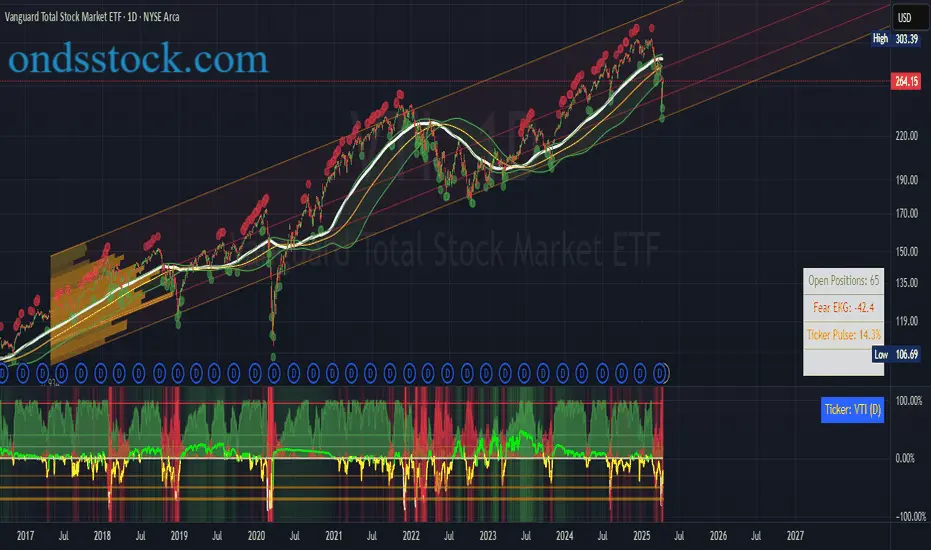
The fund’s published expense ratio is 0.04%. For context, the Lipper peer-group average expense ratio was 0.969% as of December 31, 2025. On $100,000, that gap is roughly $930 a year before any compounding effect — and fee drag compounds against you for as long as you hold.
There are no sales loads, purchase fees or redemption fees on the fund itself. Vanguard’s mutual ownership structure — the funds are owned by their shareholders rather than by outside owners — is the structural reason these costs keep drifting down rather than up.
VTSAX Performance and Historical Returns
| Period (through mid-2026) | Annualized total return |
|---|---|
| 3-year | 20.31% |
| 5-year | 11.69% |
| 10-year | 14.80% |
| Since inception (11/13/2000) | ~9.1% |
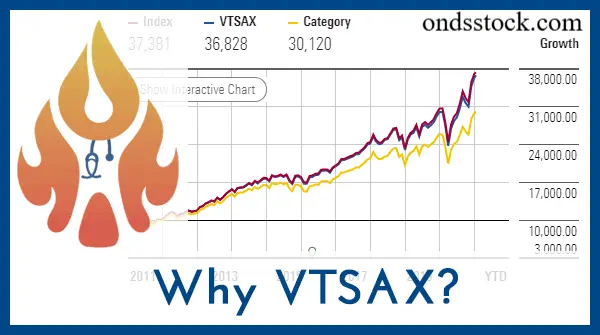
Trailing 3-, 5- and 10-year figures are 20.31%, 11.69% and 14.80% respectively, while the fund has compounded at roughly 9.13% a year since its November 13, 2000 inception. Yahoo FinanceTotal Real Returns
Those averages hide real pain. The fund lost 36.99% in 2008 and 19.53% in 2022, and finished 2015 essentially flat at 0.39%. Any investor who intends to hold for decades should assume at least one more drawdown of that size along the way.
On income: the dividend yield was 1.05% and the 30-day SEC yield 1.00% as of August 31, 2026, paid quarterly. The yield is low because the index is tilted toward companies that reinvest earnings rather than distribute them.
Minimum Investment and Share Classes
Admiral Shares (VTSAX) carry a $3,000 minimum. Investor Shares (VTSMX) are closed to new investors, and Institutional Shares (VITNX) serve large plans. Vanguard closed Investor Shares to new investors effective November 19, 2018 and converted existing holders to Admiral Shares beginning in April 2019.
If $3,000 isn’t available today, the ETF share class solves it: VTI tracks the same index at a 0.03% expense ratio, with no dollar minimum beyond the share price. StockAnalysis
How VTSAX Compares to the Main Alternatives
| Fund | What it covers | Expense ratio | Minimum |
|---|---|---|---|
| VTSAX | Total U.S. market, mutual fund | 0.04% | $3,000 |
| VTI | Same index, ETF share class | 0.03% | 1 share |
| VFIAX | S&P 500 only | 0.04% | $3,000 |
| FSKAX (Fidelity) | Total U.S. market | 0.015% | $0 |
| SWTSX (Schwab) | Total U.S. market | 0.03% | $0 |
| FZROX (Fidelity) | Total U.S. market | 0.00% | $0 |
The practical rule: hold whichever total market fund is native to your brokerage. Fidelity investors are better served by FSKAX, Schwab investors by SWTSX. Chasing a 0.01% fee difference across custodians rarely justifies the friction, and FZROX’s zero fee comes with a catch — it’s proprietary and can’t be transferred in kind to another brokerage, which matters if you ever move a taxable account.
Is VTSAX a Good Long-Term Investment?
For a U.S. equity core in a retirement account or a long-horizon taxable account, it does the job about as well as anything available: broad exposure, negligible cost, near-zero turnover, no manager risk.
Three caveats worth holding onto:
- It is 100% U.S. and 100% stocks. No bonds, no international. Pairing it with international and fixed income is a separate decision the fund doesn’t make for you.
- Concentration is real. A third-plus in one sector isn’t what most people picture when they hear “3,500 companies.”
- In taxable accounts, ETFs have a structural tax edge. VTI is generally the cleaner choice outside a retirement account.
The fund itself is simple. The behavior it requires — automatic contributions, and not selling during a 35% decline — is the hard part.
How to Buy VTSAX
- Open a brokerage or retirement account at Vanguard (IRA, Roth IRA, or taxable).
- Fund it with at least $3,000 for the initial purchase.
- Search the ticker VTSAX and place a buy order — mutual fund orders execute once daily at the closing NAV.
- Turn on automatic investing to dollar-cost average, and set dividends to reinvest.
- If $3,000 isn’t available, buy VTI instead and convert later if you prefer the mutual fund format.
4. Frequently Asked Questions
Is there anything new about the VTSAX index fund in 2026?
Yes. Vanguard renamed the fund the Vanguard Morningstar Total Stock Market Index Fund effective July 29, 2026, following Morningstar’s rebranding of the CRSP indexes, with no change to investment objectives or management. The ticker, fee and holdings are unchanged.
VTSAX vs VTI — which should I own?
They are share classes of the same fund tracking the same index. VTI charges 0.03% versus 0.04% for VTSAX, trades intraday and has no dollar minimum, and is generally more tax-efficient in taxable accounts. VTSAX suits investors who prefer automatic recurring purchases in exact dollar amounts. StockAnalysis
What is the VTSAX 20-year return?
Compounding the fund’s calendar-year returns for 2006 through 2025 (from –36.99% in 2008 to +33.52% in 2013 and +17.12% in 2025) works out to roughly 10.8% annualized, turning $10,000 into about $78,000 before taxes. Past results don’t predict future ones.
Is VTSAX a good investment?
For long-term, diversified U.S. equity exposure at minimal cost, it is among the strongest available options. It holds more than 3,500 stocks at a 0.04% expense ratio against a peer average near 0.97%. It is not appropriate as a complete portfolio for someone needing bonds, international exposure, or money within a few years.
What does the VTSAX portfolio actually hold?
3,507 U.S. stocks as of August 31, 2026, weighted by market capitalization, led by names including NVIDIA, Alphabet, Microsoft, Amazon and Broadcom, with technology around 36% of assets.
VTSAX vs VTWAX — what’s the difference?
VTSAX is U.S.-only. VTWAX holds global stocks, both U.S. and international, at a 0.09% expense ratio with the same $3,000 minimum. VTWAX is closer to a one-fund global equity solution; VTSAX needs an international fund alongside it for the same coverage.
Can I still buy Vanguard Total Stock Market Index Fund Investor Shares?
No. Investor Shares (VTSMX) closed to new investors on November 19, 2018, and existing holdings were converted to Admiral Shares starting in April 2019. Admiral Shares carry the lower fee anyway.
VTSAX vs VFIAX — is the total market worth it?
VFIAX tracks the S&P 500; VTSAX adds mid-, small- and micro-caps. Both charge 0.04% with a $3,000 minimum. Returns have been close historically because both are dominated by the same large companies. VTSAX is marginally more complete; VFIAX is marginally more concentrated in mega-caps.
Also Read