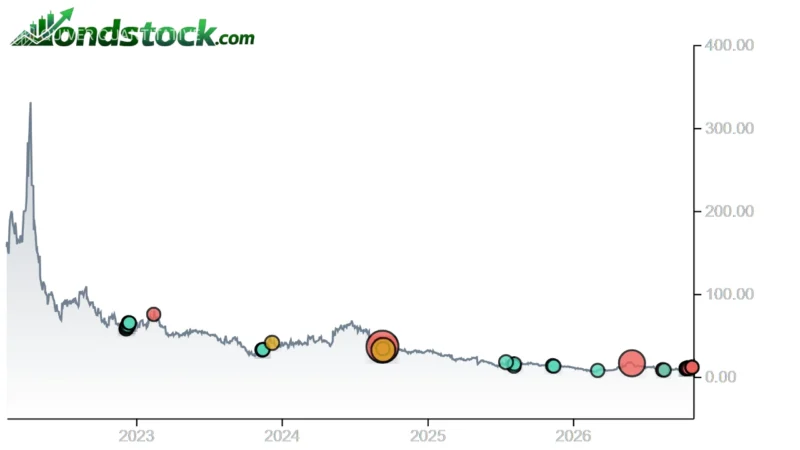

WNTR stock has attracted attention from income-focused investors because of its unusual strategy involving options and indirect inverse exposure to MicroStrategy (MSTR). Unlike traditional dividend stocks, this exchange-traded fund aims to generate weekly income through an actively managed options strategy. However, its distributions, share price movements, and investment risks require careful consideration.
The YieldMax MSTR Short Option Income Strategy ETF trades under the ticker WNTR on NYSE Arca. It launched on March 26, 2025, and is designed for investors seeking income from options premiums while gaining exposure to movements in the opposite direction of MSTR. Understanding how this strategy works is essential before considering an investment.
What Is WNTR Stock? Understanding the ETF and Its Ticker
WNTR is the ticker symbol for the YieldMax MSTR Short Option Income Strategy ETF. It is an actively managed exchange-traded fund designed to generate current income while providing indirect inverse exposure to Strategy Inc., formerly known as MicroStrategy. The fund uses an options-based approach rather than simply purchasing ordinary company shares.
The ETF began trading on March 26, 2025, on NYSE Arca. Its strategy focuses on generating weekly income through options contracts linked to MSTR shares. Unlike traditional dividend-paying companies, WNTR does not depend on business profits to distribute income. Instead, its investment results depend on options premiums, market volatility, and the performance of its underlying strategy.
WNTR Stock Price Today: Current Performance and Market Trends
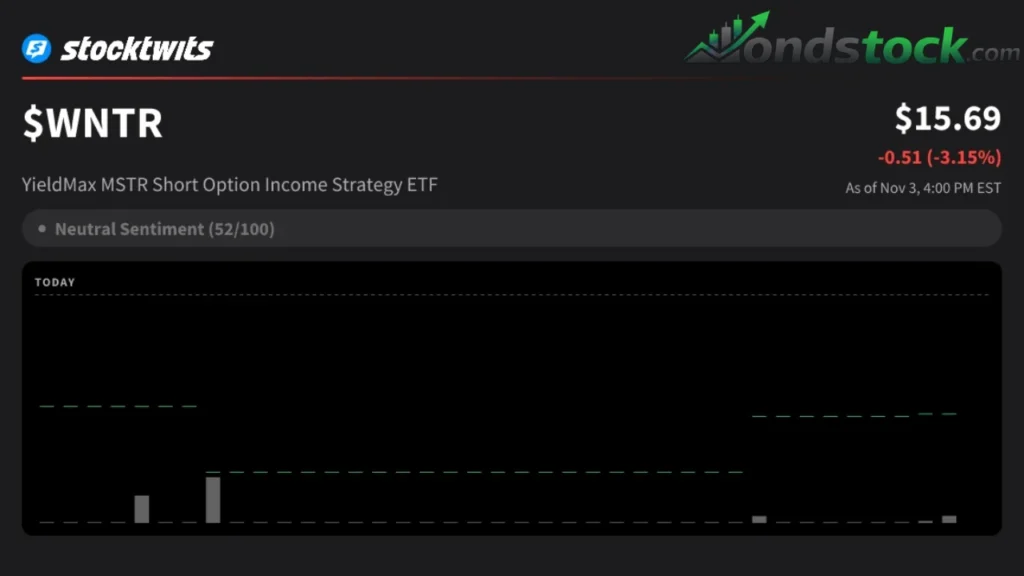
The share price is one of the first things investors examine when evaluating an ETF. According to the supplied November 4, 2026, market information, WNTR was quoted at $15.69, down $0.51 or approximately 3.15%. The reported opening price was $16.20, while its trading range reached between $15.50 and $16.20 during the session.
The ETF has also experienced considerable price fluctuations over the past year. Its reported 52-week range was $14.12 to $45.53. This wide difference highlights the importance of understanding its volatility rather than judging its performance through a single trading session. Investors should check updated market quotes because prices change throughout the trading day.
| Fund detail | Reported information |
|---|---|
| ETF name | YieldMax MSTR Short Option Income Strategy ETF |
| Ticker symbol | WNTR |
| Exchange | NYSE Arca |
| Latest supplied price | $15.69 |
| Daily price change | -3.15% |
| Opening price | $16.20 |
| Daily low | $15.50 |
| Daily high | $16.20 |
| 52-week high | $45.53 |
| 52-week low | $14.12 |
| Inception date | March 26, 2025 |
| Expense ratio | 1.00% |
| Approximate AUM | $53 million to $56 million |
The market price does not always match the fund’s net asset value. NAV represents the value of the fund’s underlying assets minus its liabilities, divided by outstanding shares. Comparing these figures helps investors understand whether WNTR trades at a premium or discount.

How Does WNTR Stock Work? Investment Strategy Explained
The fund uses an actively managed synthetic covered put strategy involving options linked to MSTR shares. In simple terms, it seeks to earn income by selling options and collecting premiums. These premiums can provide cash flow for the fund, although the amount depends on market conditions and the specific contracts used. The strategy also creates indirect inverse exposure to MSTR rather than traditional ownership of its shares.
U.S. Treasury securities can serve as collateral for the options strategy. The fund’s structure aims to benefit from certain declines in MSTR while collecting options income. However, its upside potential is capped by the structure of its options positions. This means investors should not expect it to behave exactly like a traditional short position or a simple inverse ETF.
Several factors influence its investment results:
- MSTR share price movements.
- Implied volatility in the options market.
- Options premiums and contract expiration dates.
- Changes in Treasury collateral values.
- Management expenses and trading costs.
The expense ratio is reported at 1.00%, which investors should include when evaluating potential returns. Even when the fund generates substantial options income, expenses and unfavorable market movements can reduce the overall investment result.
WNTR Stock Dividend: Distribution Rate, Payments and History
WNTR offers weekly distributions rather than traditional corporate dividends. These payments come from the fund’s investment activities and options strategy. Investors interested in regular income should understand that distributions can change from week to week. A large payment in one period does not guarantee that the following payment will be equally attractive.
The distribution history is particularly important because it helps investors evaluate payment consistency. However, historical payments should never be treated as guaranteed future income. Investors should review official announcements for the ex-dividend date, record date, payment date, and distribution amount before making decisions based on an expected payment.
| Distribution detail | What investors should check |
|---|---|
| Distribution frequency | Weekly |
| Ex-dividend date | Official fund announcement |
| Record date | Official distribution schedule |
| Payment date | Published payment announcement |
| Payment amount | Latest declared distribution |
| Distribution composition | Income, capital gains, or return of capital |
A distribution may include return of capital, which means part of the payment represents a return of an investor’s original investment rather than income earned by the fund. This distinction matters because a high distribution can occur alongside a declining NAV. Therefore, investors should evaluate total returns instead of focusing only on cash payments.
The search for a WNTR stock dividend suspension also deserves attention. A change in payment size or schedule does not automatically mean distributions have been permanently suspended. Investors should consult the official YieldMax fund page for confirmed announcements rather than relying on social media discussions or outdated dividend calendars.
Correlation Between MSTR and WNTR Stock: What Investors Should Know
The relationship between WNTR and MSTR is central to understanding this ETF. Strategy Inc., formerly MicroStrategy, has significant exposure to Bitcoin through its corporate treasury strategy. Consequently, changes in Bitcoin prices can influence MSTR shares and indirectly affect the options positions used by the fund.
Because WNTR seeks inverse exposure to MSTR, falling MSTR prices may create favorable conditions for certain parts of its strategy. However, rising MSTR prices can create losses or unfavorable results. The relationship is not a guaranteed one-to-one inverse movement because options premiums, volatility, strike prices, and expiration dates also influence performance.
Investors should remember these important differences:
- MSTR represents shares of an operating company with substantial Bitcoin exposure.
- WNTR is an actively managed ETF using an options-based income strategy.
- MSTR can experience significant gains when its shares rise.
- WNTR has capped upside potential through its options structure.
- Their daily percentage changes will not necessarily be exact opposites.
Monitoring both securities can help investors understand changing market conditions. However, historical correlation alone cannot predict future results. The options strategy introduces additional factors that can make the ETF behave differently from a conventional inverse investment.
WNTR Stock Forecast 2026: Future Outlook and Market Factors
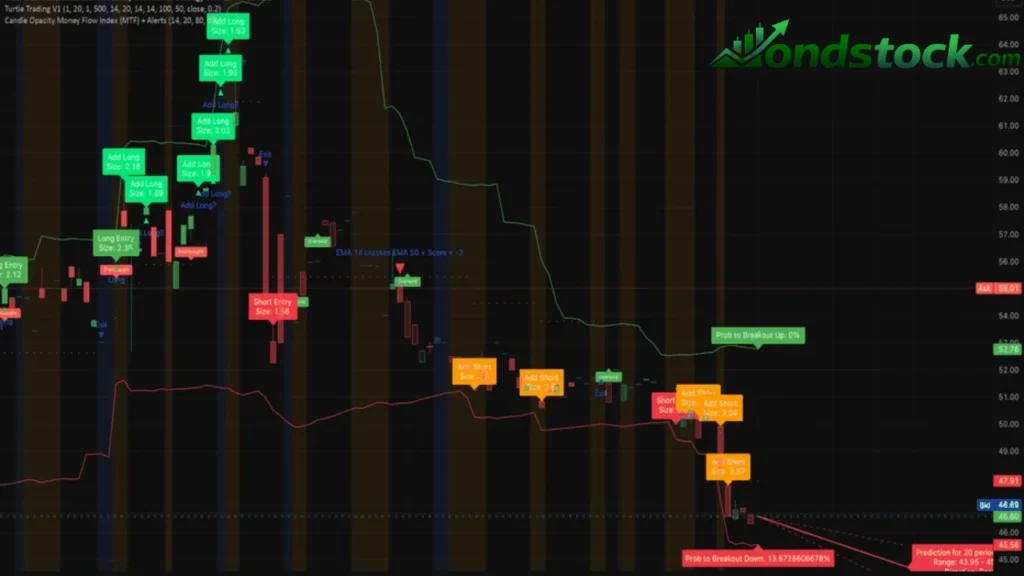
Predicting the future price of an options-based ETF is challenging because several variables influence its performance. MSTR price movements, Bitcoin market conditions, implied volatility, and options premiums can all affect its results. Investors should therefore evaluate different scenarios instead of relying on a single price target.
A favorable scenario could develop if MSTR experiences declining share prices while options premiums remain attractive. Such conditions may support the fund’s inverse exposure and income strategy. Higher implied volatility can also increase the premiums available from options contracts. However, higher volatility can create additional risks and does not automatically translate into better total returns.
A less favorable scenario could emerge if MSTR shares rise significantly. The fund may experience losses from its options positions, while its capped upside limits participation in favorable movements. Lower volatility could also reduce available options premiums, potentially affecting future distributions.
For a balanced 2026 outlook, investors should monitor:
- MSTR price movements and Bitcoin market trends.
- Changes in implied volatility.
- Weekly distribution announcements.
- NAV performance and assets under management.
- Options positioning and market conditions.
- The fund’s expense ratio and total return.
Rather than assuming that a high distribution rate guarantees attractive performance, investors should compare price changes and reinvested distributions. This approach provides a clearer picture of how the investment performs over different market periods.
WNTR Stock News: Latest Updates and Important Developments
News surrounding WNTR can influence investor expectations, particularly when it involves distribution changes, fund assets, or investment strategy updates. Since the ETF relies on options linked to MSTR, developments involving Strategy Inc. can also affect its market outlook. Investors should follow both fund announcements and relevant MSTR news.
Official fund disclosures are especially useful when reviewing changes in holdings, options positions, and payment schedules. Financial websites can provide market quotes and historical charts, but their information may be delayed or inconsistent. Checking multiple sources helps investors avoid making decisions based on outdated figures or incomplete headlines.
Useful information sources include:
- YieldMax official fund updates and distribution announcements.
- SEC filings and shareholder reports.
- Yahoo Finance for historical price information.
- StockAnalysis for ETF performance data.
- Market Chameleon for options and trading information.
Investors should pay particular attention to changes in NAV and distribution composition. These details can reveal whether cash payments are supported by the fund’s investment activities or include a return of capital.
Key Risks of Investing in WNTR Stock
Although the fund offers an interesting income strategy, it carries risks that investors should understand before purchasing shares. Its performance depends on complex options positions rather than ordinary business earnings. This structure can create unexpected results when market conditions change quickly. Investors who do not understand options trading may find it difficult to evaluate the fund’s actual exposure.
Another important concern is the possibility of capital losses despite receiving weekly distributions. Cash payments do not necessarily mean an investment is profitable. If the share price and NAV decline faster than distributions compensate for those losses, an investor’s total return can become negative. This makes regular performance monitoring essential.
The major risks include:
- MSTR price risk: A significant increase in MSTR shares can negatively affect the fund’s strategy.
- Distribution risk: Weekly payments can decrease or stop.
- NAV erosion: Repeated losses or distributions may reduce the fund’s asset value.
- Options risk: Complex contracts can produce losses under unfavorable conditions.
- Volatility risk: Changes in implied volatility can affect premiums and investment results.
- Liquidity risk: Wide bid-ask spreads may increase trading costs.
- Concentration risk: The strategy depends heavily on MSTR-related options exposure.
- Management costs: The 1.00% expense ratio reduces returns over time.
Investors should also understand that the fund is not designed to guarantee capital protection. Its income objective does not remove market risk, and its inverse exposure does not guarantee profits when MSTR declines. Reviewing the prospectus and understanding the strategy are important steps before investing.
Is WNTR Stock a Good Investment in 2026?
Whether this ETF is suitable depends on an investor’s financial goals, risk tolerance, and understanding of options strategies. Its weekly distribution structure may appeal to people looking for regular cash flow. Its indirect inverse exposure to MSTR may also attract investors who expect weakness in Strategy shares. However, these features come with meaningful complexity and potential losses.
The fund may be worth researching for experienced investors who understand options-based ETFs and can tolerate substantial price fluctuations. It may be less appropriate for conservative investors seeking stable capital growth or predictable retirement income. Anyone considering it should compare its total return, NAV changes, distribution history, and expenses with other available investment choices.
Before investing, consider the following questions:
- Do you understand how synthetic covered put strategies work?
- Can you tolerate a significant decline in the share price?
- Are you comfortable with variable weekly distributions?
- Have you reviewed the fund’s latest prospectus?
- Does the ETF fit your broader portfolio strategy?
A careful evaluation is more useful than choosing an ETF simply because its distribution rate appears attractive. Investors should consider both potential income and the possibility of losing their original capital.
Conclusion
WNTR offers a specialized approach to generating income through options linked to MSTR shares. Its weekly distribution structure and indirect inverse exposure make it different from traditional dividend ETFs. However, its performance depends on market volatility, options premiums, MSTR movements, and the fund’s investment decisions.
Investors researching this ETF should look beyond its distribution rate and examine NAV performance, historical payments, expenses, and total returns. Its strategy may interest experienced investors, but it also involves meaningful risks. Understanding these factors can help investors make more informed decisions when evaluating its role in a diversified portfolio.
Frequently Asked Questions About WNTR
What is WNTR stock?
WNTR is the YieldMax MSTR Short Option Income Strategy ETF, an actively managed fund designed to generate income with indirect inverse exposure to MSTR.
What is the WNTR stock ticker symbol?
WNTR is the ticker symbol for the YieldMax MSTR Short Option Income Strategy ETF, which trades on NYSE Arca.
What is the current WNTR stock price?
The supplied November 4, 2026, quote was $15.69, but investors should check live market data for the latest price.
Does WNTR pay dividends?
WNTR makes weekly ETF distributions generated through its options-based investment strategy, although payment amounts are not guaranteed.
What is the WNTR stock dividend history?
Its distribution history includes previous payment amounts and dates, which investors can review through official YieldMax announcements.
Has the WNTR stock dividend been suspended?
A permanent suspension should not be assumed without an official announcement from YieldMax confirming a change to its distribution policy.
What is the correlation between MSTR and WNTR?
WNTR seeks indirect inverse exposure to MSTR, but their daily price movements are not guaranteed to be exact opposites.
Is WNTR a good investment in 2026?
It may suit experienced investors seeking options-based income and inverse MSTR exposure, but its volatility, distribution uncertainty, and capital risks require careful evaluation.
Also Read…