
Before anything else, the fact that changes most people’s search: Vanguard PRIMECAP Fund is closed to new investors.
You cannot simply open a brokerage account today and buy VPMAX.
That single detail reframes every other question about this fund, so it’s worth understanding what you’d be getting — and what your realistic options are if you’re on the outside.
What is the Vanguard PRIMECAP Fund?
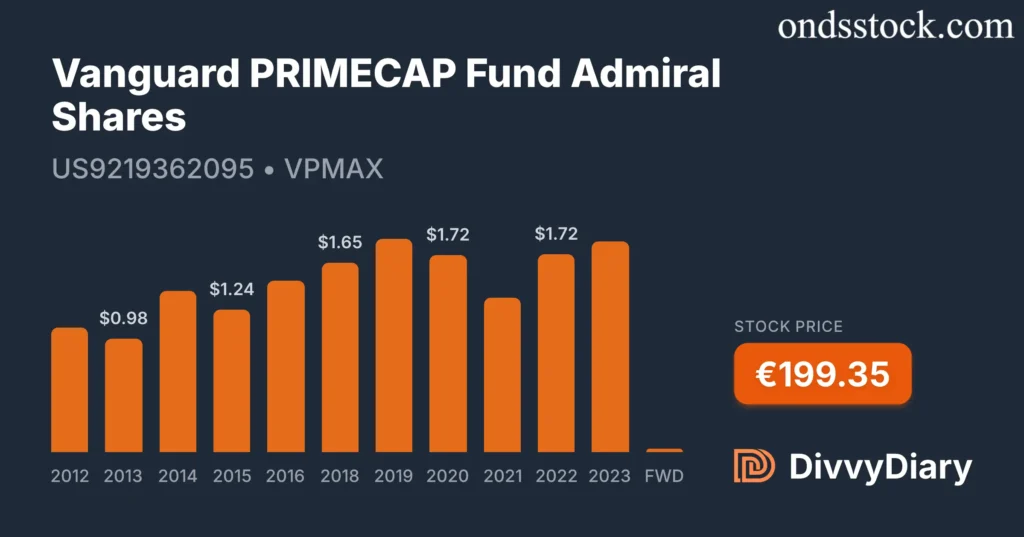
Vanguard PRIMECAP Fund is an actively managed domestic stock fund that seeks long-term capital appreciation by buying growth-oriented companies at valuations the managers consider attractive.
It has two share classes: Investor Shares (VPMCX) and Admiral Shares (VPMAX). Same portfolio, same managers — Admiral Shares simply charge less in exchange for a higher balance requirement.
Quick facts (Vanguard fact sheet, June 30, 2026, unless noted):
| Detail | Vanguard PRIMECAP Admiral Shares |
|---|---|
| Ticker | VPMAX |
| Share class inception | November 12, 2001 |
| Expense ratio | 0.27% (as of 1/28/26) |
| Lipper peer average | 0.85% (as of 12/31/25) |
| Total net assets (all classes) | ~$90.2 billion |
| Turnover rate | 10.9% |
| Number of holdings | 177 (as of 8/31/26) |
| Dividend yield | 0.80% (as of 8/31/26) |
| Benchmark | S&P 500 Index |
| Admiral minimum | $50,000 |
The strategy in one line: buy out-of-favor companies with above-average earnings growth potential that isn’t reflected in current market prices, then hold them for years.
Who actually runs the fund?
PRIMECAP Management Company, founded in 1983 and based in Pasadena, California. Vanguard distributes and administers the fund; PRIMECAP does the stock picking.
The structure is unusual and worth understanding, because it explains the fund’s behavior. Five portfolio managers each run a separate subportfolio with full autonomy over their sleeve. There’s no committee vote and no house view to conform to. The team:
- Theo A. Kolokotrones, Chairman Emeritus — advising the fund since 1984
- Joel P. Fried, Chairman — since 1993
- Alfred W. Mordecai, President — since 1997
- M. Mohsin Ansari, Vice-Chairman — since 2007
- James Marchetti, Executive Vice President — since 2015
Tenure like that is rare in active management. The longest-serving manager has been on this portfolio for over four decades.
How the investment strategy works
Three features define the PRIMECAP approach, and each has a measurable fingerprint in the portfolio.
1. Genuinely long holding periods. Managers expect to own a company for at least three to five years. The result is a 10.9% turnover rate — roughly a nine-year average holding period, against a typical active equity fund that turns over a meaningful share of its book annually. Low turnover also means lower trading costs and fewer taxable distributions than most actively managed peers.
2. Buying discomfort. The fund deliberately targets out-of-favor companies and industries — businesses the market has written off but where the managers see durable earnings growth. This is why the portfolio has historically held names other growth funds abandoned.
3. Independent, fundamental research. The managers rely almost exclusively on their own analysis rather than Wall Street consensus.
The trade-off: this approach can look wrong for years at a time. That’s the price of admission.
Portfolio and holdings: a concentrated book
Despite holding 177 securities, the fund’s top ten holdings represented 45.8% of total net assets as of June 30, 2026 — well above the 30%–40% range Vanguard cites as typical. This is a concentrated portfolio wearing a diversified fund’s clothing.
Ten largest holdings (June 30, 2026):
- Micron Technology
- Intel
- Eli Lilly
- Alphabet
- KLA Corp.
- AstraZeneca
- NVIDIA
- Amazon.com
- Tesla
- Biogen
Two entries there — Micron and Intel — are a clean illustration of the strategy. Both were widely disliked semiconductor stories that the fund held through extended underperformance. In the quarter ended June 30, 2026, Vanguard reported Micron (+242%) and Intel (+216%) among the top contributors to results. stockinvest.us
Sector allocation
| Sector | Weight |
|---|---|
| Information Technology | 40.3% |
| Health Care | 20.6% |
| Industrials | 12.9% |
| Consumer Discretionary | 9.9% |
| Communication Services | 6.7% |
| Financials | 6.3% |
| Energy | 1.1% |
| Consumer Staples | 1.0% |
| Materials | 1.0% |
| Real Estate | 0.1% |
Roughly 61 cents of every dollar sits in technology and healthcare. Consumer staples, the classic defensive ballast, is effectively absent at 1.0%. If you already own a tech-heavy portfolio, this fund compounds that exposure rather than offsetting it.
Performance: how VPMAX compares to the S&P 500
Short answer: the fund has outpaced its benchmark across every standard trailing period through mid-2026, and by a wide margin recently.
Average annual returns, periods ended June 30, 2026:
| Period | VPMAX | S&P 500 Index |
|---|---|---|
| Quarter | 34.22% | 15.20% |
| Year to date | 30.52% | 10.21% |
| 1 year | 58.75% | 22.32% |
| 3 years | 28.31% | 20.61% |
| 5 years | 16.76% | 13.41% |
| 10 years | 18.56% | 15.51% |
A useful counterweight to those headline numbers: a $10,000 investment over the ten calendar years ending December 31, 2025 grew to $41,332 in the fund versus $39,827 in the benchmark. Real but modest — roughly a 3.8% edge over a decade. Most of the dramatic outperformance in the trailing table arrived in a concentrated burst during 2025–2026.
The calendar-year record shows how lumpy this is. The fund returned 13.52% in 2024 against the benchmark’s 25.02% — an 11.5-point shortfall — then 29.99% in 2025 against 17.88%. It also lagged in 2016, 2018 and 2019, and fell 15.09% in 2022.
Original takeaway: this fund’s edge is not a steady drip. It arrives in clusters, usually when a contrarian position the managers held through years of pain finally re-rates. An investor who bought after a hot stretch and sold after a cold one would likely have captured the reverse of these numbers. Holding period is not a footnote here — it’s the whole thesis.
Expense ratio and fees

At 0.27%, VPMAX costs about a third of the 0.85% Lipper peer average for comparable funds. On a $100,000 position that’s roughly $270 a year versus $850.
| Investor (VPMCX) | Admiral (VPMAX) | |
|---|---|---|
| Expense ratio | 0.35% | 0.27% |
| Account minimum | $3,000 | $50,000 |
| Sales loads | None | None |
The classes are otherwise identical. Vanguard converts eligible Investor Share balances to Admiral Shares, so long-term holders typically drift into the cheaper class on their own.
Worth keeping in perspective: 0.27% is cheap for active management, but a broad index fund can be had for under 0.05%. You’re paying roughly 20–25 basis points a year for PRIMECAP’s stock selection.
Can you still buy VPMAX?
This is where most articles are vague, so let’s be precise. Per the fund’s prospectus:
- The fund is closed to new accounts for investors not enrolled in Vanguard Flagship Services or Vanguard Personal Advisor Services.
- Clients of those services may open new fund accounts, investing up to $25,000 per fund account per year.
- Existing shareholders may add up to $25,000 per fund account per calendar year. Reinvested dividends and capital gains don’t count toward that cap.
- Participants in certain qualified retirement plans may continue investing under their plan’s terms.
Practically, that leaves three doors: you already own it, your employer’s 401(k) offers it, or you qualify for Vanguard’s higher-tier advisory relationships. If none apply, no broker can get you in — this isn’t a Fidelity-versus-Schwab question.
Alternatives worth looking at
If VPMAX is out of reach, these are the closest relatives — but verify current availability in each fund’s prospectus, since access rules change:
- PRIMECAP Odyssey Funds (POSKX, POGRX, POAGX) — run by the same PRIMECAP Management team directly, with the same subportfolio structure. Minimums are far lower ($2,000 regular, $1,000 retirement for the Aggressive Growth Fund as of its February 2026 prospectus). Expense ratios are higher than Vanguard’s.
- Vanguard Capital Opportunity Fund (VHCOX/VHCAX) and Vanguard PRIMECAP Core Fund (VPCCX) — also PRIMECAP-advised, also subject to purchase restrictions.
- Vanguard Growth Index Fund (VIGAX) or Vanguard Total Stock Market Index Fund (VTSAX) — not equivalent, but a low-cost way to own growth exposure without manager risk.
Frequently Asked Questions
What’s the latest on Vanguard PRIMECAP Admiral Shares today?
As of the most recent Vanguard data available for this article, VPMAX carried a 0.27% expense ratio, held 177 securities and had about $85.1 billion in share-class assets (August 31, 2026), with a year-to-date return of 20.67% through September 16, 2026. Fund prices and returns change daily — check vanguard.com/performance for current figures.
What do Reddit investors say about VPMAX?
Discussion in communities like r/Bogleheads tends to cluster around two themes: long-time holders who value the low turnover and manager tenure, and newer investors frustrated that the fund is closed. Treat forum commentary as anecdote, not analysis — none of it is a substitute for the prospectus and fact sheet.
Is Vanguard PRIMECAP Admiral Shares a good investment?
It has a strong long-term record — 18.56% annualized over ten years through June 30, 2026 versus 15.51% for the S&P 500 — at a low cost for an active fund. The trade-offs are real: 40.3% in information technology, a top-ten stake equal to 45.8% of assets, and multi-year stretches of underperformance. It suits investors with a long horizon who already hold it or can access it.
What is the price of VPMAX?
VPMAX is a mutual fund, so it prices once daily at net asset value after the U.S. market close, not continuously like a stock. Current NAV is published on Vanguard’s site and major financial data providers.
What are Vanguard PRIMECAP Fund Investor Shares?
VPMCX is the higher-cost share class of the same fund — 0.35% expense ratio, $3,000 minimum, identical portfolio and managers. It carries the same closure restrictions as Admiral Shares.
Is there a Vanguard PRIMECAP ETF?
No. There is no ETF share class of the Vanguard PRIMECAP Fund. The strategy is offered only as a mutual fund through Vanguard and through PRIMECAP Management’s own Odyssey fund family.
What exactly is VPMAX?
VPMAX is the ticker for Vanguard PRIMECAP Fund Admiral Shares, launched November 12, 2001, advised by PRIMECAP Management Company and benchmarked to the S&P 500 Index.
What other Vanguard PRIMECAP funds exist?
Three Vanguard funds are advised by PRIMECAP Management: Vanguard PRIMECAP Fund (VPMCX/VPMAX), Vanguard PRIMECAP Core Fund (VPCCX) and Vanguard Capital Opportunity Fund (VHCOX/VHCAX). All have faced purchase restrictions at various points.
Also Read
Snowball Analytics Review 2026
VOO Dividend
Global Economic Outlook 2026–2027
SDGE Peak Hours 2026