The GS dividend has become an increasingly important part of the shareholder-return story for Goldman Sachs as the financial giant continues to combine regular dividends with substantial share repurchases.
As of September 2026, Goldman Sachs pays a $5.00 quarterly dividend per common share, equivalent to a $20 annualized payout if that quarterly rate is maintained. The company increased its quarterly dividend from $4.50 to $5.00 in July 2026, representing an 11% increase from the previous quarterly rate and a 25% increase from the prior year.
For investors researching Goldman Sachs as an income stock, however, the dividend should not be viewed in isolation. Buybacks, earnings, capital requirements, valuation, interest rates and the firm’s ability to generate sustainable profits all influence the overall shareholder-return picture.
Goldman Sachs Dividend Overview
In short: Goldman Sachs pays a quarterly dividend and has continued increasing its payout over time.
The company operates under the ticker GS on the New York Stock Exchange. Its dividend is generally paid four times per year, making it a quarterly dividend stock rather than a monthly income investment.
| GS Dividend Metric | 2026 Information |
|---|---|
| Quarterly dividend | $5.00 |
| Annualized dividend | $20.00 |
| Payment frequency | Quarterly |
| September 2026 ex-dividend date | September 1, 2026 |
| September 2026 payment date | September 29, 2026 |
| 2026 January quarterly dividend | $4.50 |
| 2025 year-end quarterly dividend | $4.00 |
The September 2026 $5.00 payment represents the latest step in the company’s dividend-growth strategy. Goldman Sachs said after the 2026 Federal Reserve stress test that it intended to increase the common dividend while maintaining its focus on a sustainable and growing payout.
GS Dividend Yield and Annual Payout
The annualized GS dividend is currently $20 per share based on the $5.00 quarterly rate.
Dividend yield changes with the stock price, so it is important not to treat the percentage as a fixed number. A simple calculation is:
Dividend Yield = Annual Dividend ÷ Share Price × 100
Different market-data providers can show slightly different yields depending on whether they use the trailing 12-month payout or annualize the latest quarterly dividend.
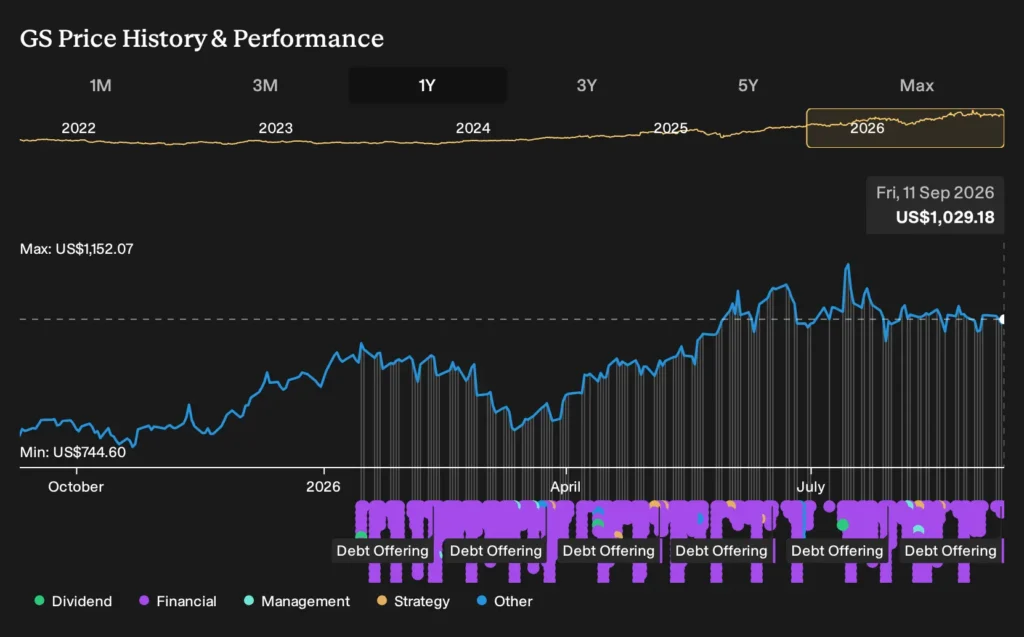
For example, one data provider lists the annualized dividend at $20 and the yield near 1.9% in September 2026, while Morningstar’s data shows an approximately 1.75% trailing dividend yield.
That distinction matters when comparing GS with other dividend stocks.
How Much Does GS Pay in Dividends Per Share?
Goldman Sachs currently pays $5.00 per share every quarter based on its latest declared rate.
An investor holding 100 GS shares would therefore receive:
- $500 per quarter
- $2,000 per year, assuming the $5.00 quarterly rate remains unchanged
- Before taxes and other applicable adjustments
The actual amount received by an investor depends on the number of shares owned and whether the investor held the stock before the applicable ex-dividend date.
The September 2026 dividend has an ex-dividend date of September 1 and a scheduled payment date of September 29.
GS Dividend History and Growth Rate
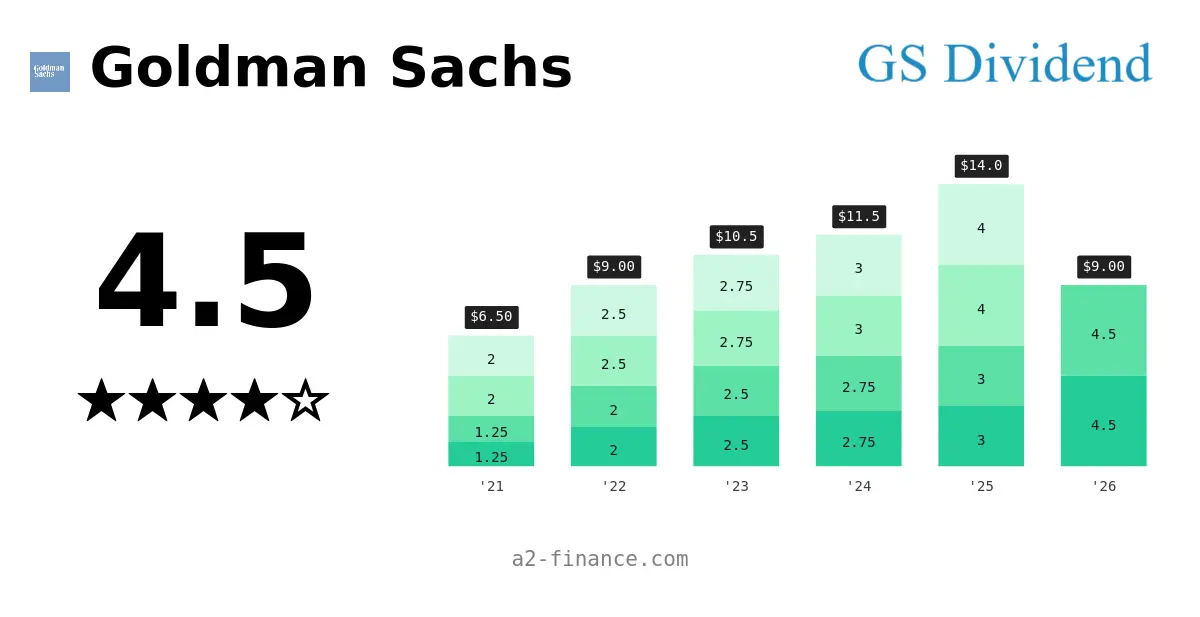
Goldman Sachs has steadily increased its dividend over the long term, although its payout history reflects the cyclical nature and regulatory environment of the banking industry.
Recent quarterly payments demonstrate the progression:
| Period | Quarterly Dividend |
|---|---|
| 2022 | $2.00–$2.50 |
| 2023 | $2.50–$2.75 |
| 2024 | $2.75–$3.00 |
| 2025 | $3.00–$4.00 |
| 2026 | $4.50–$5.00 |
The company paid $14.00 per share in dividends during 2025 according to Morningstar’s historical data. The annualized rate has subsequently moved higher with the 2026 increases.
This history is more useful than looking only at the current dividend yield because it shows how Goldman Sachs has increased the cash distribution over time.
GS Dividend Growth Rate Over 3, 5, and 10 Years
Dividend growth is particularly important for investors who want income to rise over time rather than simply seeking the highest current yield.
Recent data providers report strong multi-year dividend growth for GS. Investing.com, for example, reports a five-year dividend growth rate of approximately 27.7%, although exact growth calculations can vary depending on methodology and the dates selected.
The key takeaway is that Goldman Sachs has not relied solely on a high starting yield. Its strategy has also involved increasing the dollar amount paid per share.
For long-term investors, this can potentially help dividend income keep pace with inflation, although future increases are never guaranteed. dividend.com
GS Dividend Payout Ratio and Safety
A relatively low payout ratio can provide a useful cushion because a company does not need to distribute most of its earnings to maintain its dividend.
Current third-party estimates place Goldman Sachs’ payout ratio around the high-20% to low-30% range, depending on whether the calculation uses trailing earnings, estimated earnings or cash flow.
Goldman Sachs also remains subject to bank-specific capital requirements. Following the 2026 Comprehensive Capital Analysis and Review, the Federal Reserve maintained the firm’s stress capital buffer at 3.4% through September 30, 2027, while Goldman Sachs reported a CET1 requirement of 11.4%.
This is important because dividend decisions at major banks are influenced not only by earnings but also by regulatory capital and stress-test results.
GS Ex-Dividend Date and Payment Schedule
The latest September 2026 GS dividend has an ex-dividend date of September 1, 2026, with a $5.00 payment scheduled for September 29, 2026.
Goldman Sachs generally pays dividends quarterly.
Investors should always check the company’s latest announcement before buying shares specifically to qualify for a dividend. The ex-dividend date is particularly important because buying after that date generally means the buyer will not receive that particular distribution.
GS Dividend Calculator: Forecast Your Returns
A simple dividend calculator can estimate annual income from GS shares.
Annual Dividend Income = Number of Shares × Annual Dividend Per Share
Using the current $20 annualized rate:
- 10 shares = $200 annual dividend
- 50 shares = $1,000 annual dividend
- 100 shares = $2,000 annual dividend
- 250 shares = $5,000 annual dividend
- 500 shares = $10,000 annual dividend
These calculations assume the $5.00 quarterly dividend remains unchanged for the full year.
They do not account for taxes, dividend changes, additional purchases or reinvestment.
GS Dividend Income Calculator
For a more realistic estimate, investors can consider three variables:
- Number of GS shares
- Current annualized dividend
- Dividend growth or reinvestment assumption
For example, an investor with 100 shares would currently estimate $2,000 in annual dividend income. If future dividend increases occur, that income could rise without purchasing additional shares.
However, a dividend forecast is not a guarantee. Goldman Sachs’ board determines future dividends, and financial institutions can adjust capital distributions when business conditions or regulatory requirements change.
DRIP vs. No DRIP: The Dividend Snowball Effect
A dividend reinvestment plan, commonly called DRIP, uses dividend payments to purchase additional shares.
Without reinvestment, a shareholder receives cash.
With reinvestment:
Dividend → More Shares → Larger Future Dividend → More Shares
This is the classic dividend snowball effect.
DRIP can be useful for investors focused on long-term compounding, while taking dividends as cash may be more appropriate for investors who need current dividend income.
Neither approach is automatically better. The right choice depends on investment objectives, taxes, valuation and portfolio needs.
Is GS a Good Dividend Stock in 2026?
GS can be attractive for dividend investors who prioritize dividend growth and total shareholder returns, but it is not primarily a high-yield stock.
Its appeal comes from several factors:
- Growing quarterly dividend
- Strong history of dividend increases
- Relatively modest payout ratio
- Significant share repurchases
- Large and diversified financial-services business
- Potential for earnings growth across market cycles
Goldman Sachs reported that it returned $16.78 billion of capital to common shareholders during 2025, including $12.36 billion through common share repurchases and $4.42 billion through dividends.
That demonstrates why investors should look beyond dividend yield when evaluating GS.
Goldman Sachs Dividend Investment Outlook
The broader market environment can influence Goldman Sachs’ earnings and capital-return capacity.
Interest rates, economic growth, investment banking activity, asset management, trading conditions and investor sentiment can all affect the company’s results.
The Federal Reserve is particularly important for financial stocks because changes in interest rates can influence borrowing costs, market activity and economic conditions.
As of September 2026, Goldman Sachs economists have shifted toward expecting a September Federal Reserve rate increase, illustrating how quickly the interest-rate outlook can change.
For dividend investors, the important point is that GS should be evaluated across a range of market conditions rather than based on one interest-rate forecast.
GS Total Shareholder Return: Dividends and Buybacks
One of the strongest arguments for GS is its combination of dividends and stock buybacks.
A dividend gives shareholders direct cash.
A share repurchase reduces the number of outstanding shares, potentially increasing each remaining shareholder’s percentage ownership and supporting earnings per share.
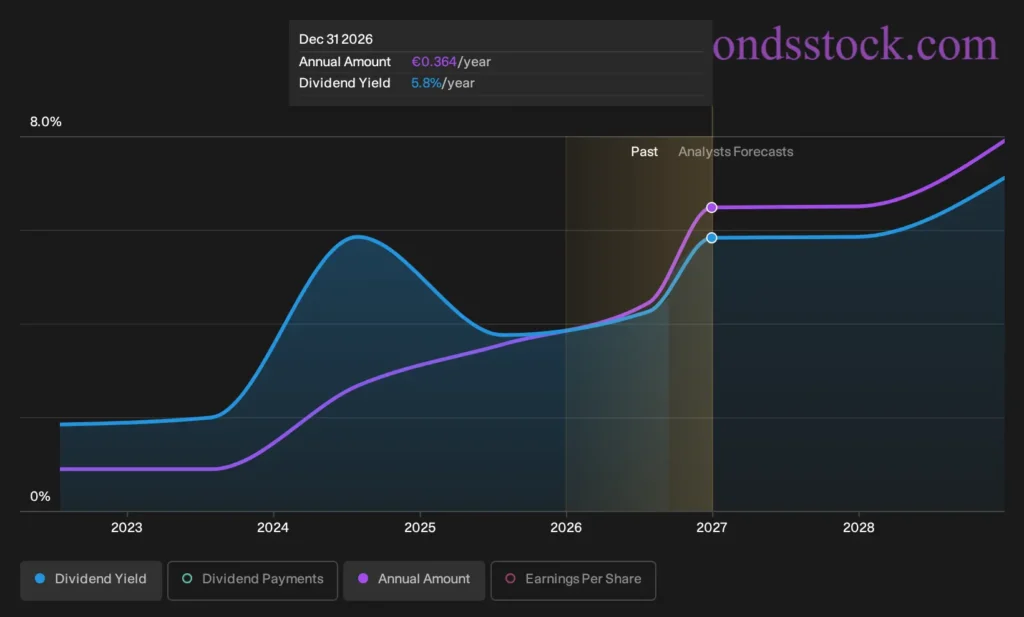
Morningstar’s September 2026 data shows GS with a trailing dividend yield of about 1.75% and a buyback yield of about 4.67%, producing a total yield of approximately 6.42% under its methodology.
This illustrates why combined buyback and dividend yield can provide a more complete picture of capital returns than dividend yield alone.
Goldman Sachs vs. Other Dividend Stocks
GS is different from traditional high-yield income stocks.
Investors comparing it with other financial companies such as JPMorgan Chase, Bank of America or Morgan Stanley should examine:
- Dividend yield
- Dividend growth
- Payout ratio
- Buyback yield
- Earnings growth
- Return on equity
- Capital requirements
- Valuation
- Balance-sheet strength
Current market data shows GS’s dividend yield is in a similar broad range to several large financial peers rather than standing out as an exceptionally high-yield stock.
Therefore, GS may appeal more to investors seeking a combination of income, dividend growth and capital appreciation than to investors looking exclusively for the highest current yield.
What Analysts Say About Goldman Sachs Stock
Analyst ratings and price targets can provide additional context, but they should not be treated as guarantees of future performance.
A Strong Buy rating or Moderate Buy rating reflects an analyst’s assessment at a particular point in time. Price targets can also change quickly when earnings, interest rates or market conditions change.
Investors should therefore use analyst ratings alongside fundamentals such as:
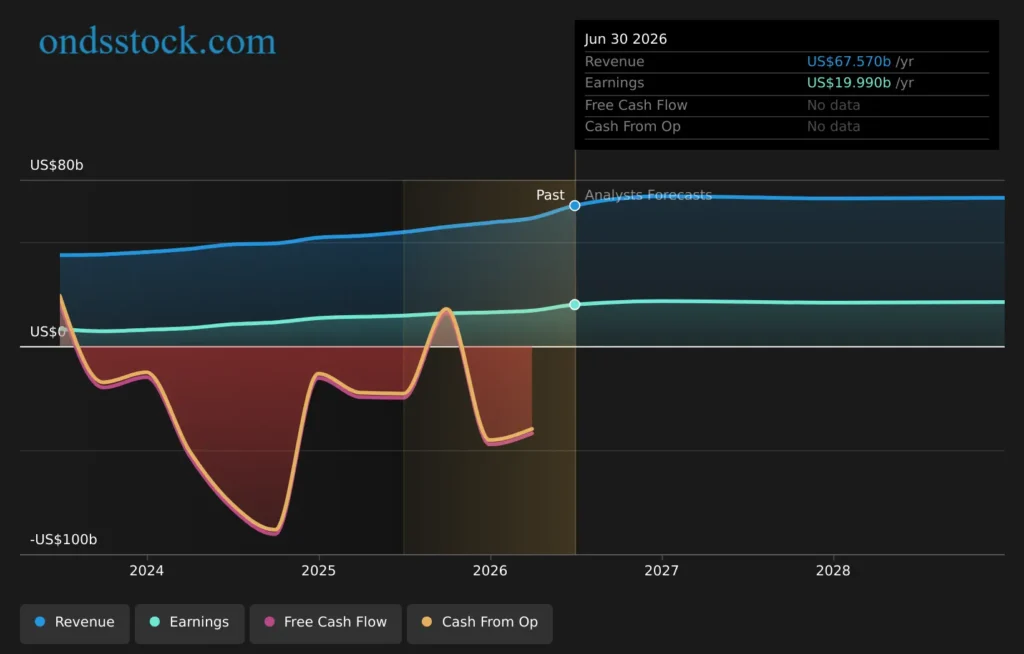
- Revenue growth
- Earnings
- Free cash flow
- Capital allocation
- Dividend coverage
- Share repurchases
- Valuation
- Economic conditions
This is particularly relevant for a financial company because market volatility can materially affect trading and investment-banking activity.
Factors That Could Affect GS Dividend Growth
Several factors could influence future dividend increases:
Earnings Growth
Higher sustainable earnings can give Goldman Sachs greater flexibility to increase shareholder distributions.
Regulatory Capital
Banks must maintain adequate capital, and regulatory requirements can affect how much money is available for dividends and buybacks.
Market Conditions
Strong capital-market activity can support Goldman Sachs’ investment-banking and trading businesses, while prolonged market weakness can create pressure.
Interest Rates
Changes in Federal Reserve policy can influence financial-market activity and the broader economy.
Share Repurchases
The company’s capital allocation strategy includes both dividends and buybacks, so investors should monitor the balance between these two methods of returning cash.
Is Goldman Sachs Dividend Sustainable?
The current GS dividend appears supported by a relatively moderate payout ratio and the company’s stated commitment to a sustainable and growing dividend. Goldman Sachs also demonstrated substantial capital returns in 2025 and remained well capitalized in the 2026 stress-test results.
Still, sustainability should never be interpreted as a guarantee.
Bank dividends can be affected by earnings volatility, regulatory decisions, capital requirements and severe economic stress.
For that reason, investors should monitor quarterly earnings and official dividend announcements rather than assuming today’s payout will remain unchanged indefinitely.
Pros and Cons of Investing in GS for Dividends
Pros
- Growing quarterly dividend
- Strong dividend-growth history
- Moderate payout ratio
- Significant share repurchases
- Diversified financial-services business
- Potential for both income and capital appreciation
Cons
- Dividend yield is not especially high compared with some income-focused stocks
- Financial-sector earnings can be cyclical
- Regulatory capital requirements can affect distributions
- Stock valuation can influence the effective yield
- Dividend increases are not guaranteed
Frequently Asked Questions About GS Dividend
What was the Goldman Sachs GS dividend in 2022?
In 2022, Goldman Sachs paid quarterly dividends that increased from $2.00 to $2.50 per share during the year. Historical dividend data shows payments of $2.00 in the first two quarters and $2.50 in the latter part of 2022.
What is the GS dividend in 2026?
The latest GS dividend rate in 2026 is $5.00 per share per quarter, or $20 on an annualized basis if the rate remains unchanged. Goldman Sachs increased the quarterly dividend from $4.50 to $5.00 beginning in July 2026.
What was the Goldman Sachs dividend announcement in 2026?
Goldman Sachs announced in June 2026 that it intended to increase its common dividend from $4.50 to $5.00 per share beginning July 1, 2026, subject to approval by its board.
What was the GS dividend in 2025?
Goldman Sachs paid $3.00 per share during much of 2025 before increasing the quarterly payout to $4.00 for the December 2025 payment.
What is the GS dividend history?
GS has increased its dividend substantially over the past several years. Annual dividend-per-share data reported by Morningstar rose from $9.00 in 2022 to $10.50 in 2023, $11.50 in 2024 and $14.00 in 2025.
Has GS increased its dividend?
Yes. The latest increase took the quarterly dividend from $4.50 to $5.00, an increase of approximately 11%. Goldman Sachs described the move as part of its strategy of maintaining a sustainable and growing dividend.
What is the Goldman Sachs dividend yield?
The exact yield changes with the GS share price. In September 2026, market-data sources place the yield around the high-1% range, although figures vary depending on whether the calculation uses the annualized current payout or trailing dividends.
Is GS a good dividend stock?
GS may suit investors seeking a combination of dividend growth, share repurchases and potential capital appreciation rather than investors looking exclusively for a high current yield. Future returns depend on the company’s earnings, valuation, capital allocation and broader market conditions.
How often does Goldman Sachs pay dividends?
Goldman Sachs pays its common-stock dividend quarterly, or four times per year.
When is the next GS ex-dividend date?
As of September 15, 2026, the most recent GS ex-dividend date was September 1, 2026, for the $5.00 quarterly dividend scheduled to be paid on September 29, 2026.
Is the GS dividend sustainable?
The current payout is supported by a relatively moderate payout ratio, continued capital generation and Goldman Sachs’ strong regulatory-capital position. However, future dividends remain subject to earnings, capital requirements, market conditions and board decisions.
What is the difference between GS dividend yield and buyback yield?
Dividend yield measures the cash dividend paid relative to the stock price. Buyback yield measures the effect of share repurchases relative to the company’s market value. Looking at both can provide a broader view of shareholder returns.
Does GS return more cash through dividends or buybacks?
Goldman Sachs has recently returned substantial amounts through both methods. In 2025, it returned $12.36 billion through common share repurchases and $4.42 billion through common stock dividends.
Also Read:
Oracle Dividend Quick Guide
IREN Stock Analysis
Intu Stock Forecast
Tesla Stock Price Prediction 2030