
Short answer: First Solar is profitable, holds net cash and has a multi-year backlog. Its stock is also down roughly a third this year, and the drop reflects real risks around interest rates, tax credits and module pricing. Whether it’s a buy depends on how much of that policy and financing risk you’re willing to carry. This is general information, not personalized financial advice.
What happened to FSLR stock in September 2026?
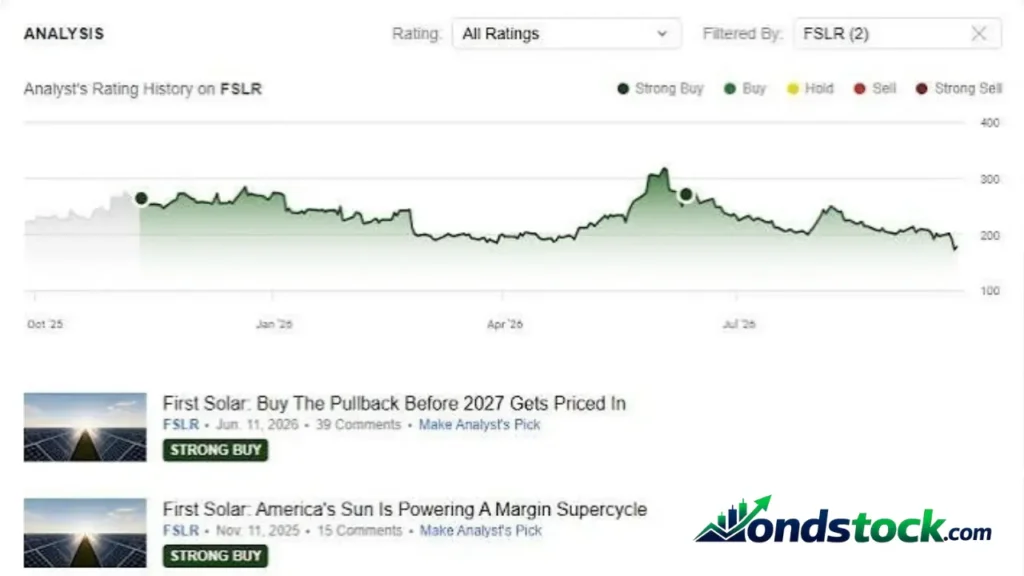
Shares fell about 10% on September 24 to close near $172, roughly 46% below the 52-week high of $320.95. The stock hit a new 52-week low of $170.80 that day.
The likely trigger was financing costs. Elevated borrowing costs pressured solar stocks, and First Solar had the largest decline among major solar names, though no company-specific reason was established. That fits how the business works: utility-scale solar projects need heavy upfront capital, so higher yields can delay the projects that buy First Solar’s panels. tipranks
Sentiment has since steadied. KeyBanc upgraded the stock to Sector Weight from Underweight on September 28, citing valuation. Yahoo Finance
What does First Solar actually make?
First Solar manufactures thin-film solar modules using cadmium telluride (CdTe) as the semiconductor, rather than the polysilicon used in conventional crystalline silicon panels. The company is headquartered in Phoenix, Arizona, and sells to developers, independent power producers, utilities and large corporate energy buyers.
Two features matter for investors:
- No Chinese polysilicon dependency. The Louisiana plant has no dependencies on Chinese crystalline silicon supply chains, supporting compliance with expected Foreign Entity of Concern (FEOC) guidance.
- Fast, integrated production. A continuous process converts a sheet of glass into a finished panel in about four hours.
How did First Solar’s latest earnings look?
Q2 2026 (reported July 30) was strong on profit and softer on sales.
| Metric | Q2 2026 |
|---|---|
| Net sales | $1.06B (down about 4% year over year) |
| Diluted EPS | $3.92 (up 23%) |
| Adjusted EBITDA | $644M |
| Gross margin | ~57% |
| Net cash | ~$1.7B |
| Contract backlog | ~45.1 GW through 2030 |
Sources: company press release and earnings call summary.
EPS of $3.92 beat the $2.82 consensus estimate, and management reaffirmed 2026 guidance of $4.9-$5.2 billion in net sales and $2.6-$2.8 billion in adjusted EBITDA.
One thing worth knowing: the margin jump wasn’t purely operational. The 10-Q attributes the gain partly to expected IEEPA tariff refunds net of amounts payable to customers, more modules qualifying for the Section 45X credit, and lower logistics costs. A portion of that is non-recurring or policy-driven, so don’t extrapolate 57% blindly.
The backlog also shrank, from 47.9 GW heading into the quarter to 45.1 GW. Management cited customer contract terminations as a drag on revenue.
How much does the Section 45X tax credit matter?
Enormously. The Section 45X advanced manufacturing credit lets First Solar monetize a credit for each US-made module. Guidance assumes $2.10-$2.19 billion of 45X credits in 2026, which is a large share of the $2.6-$2.8 billion EBITDA target.
KeyBanc estimated that these credits plus cash are worth about $135 per share combined. That helps explain why some analysts see downside as limited, and why bears focus on what happens if policy changes. Under current law the credit steps down in the early 2030s, and a nearer-term risk is that Washington trims it sooner. Verify the current phase-out schedule before relying on any specific year.
How do Section 232 tariffs affect First Solar?
They look like a net positive, though the details are still settling. A proclamation signed August 6, 2026 imposes a 15% tariff on certain polysilicon derivatives plus minimum import prices, effective December 4, 2026. The floors include $0.38 per watt for modules and $0.22 per watt for cells.
One procurement analyst argues First Solar’s CdTe modules fall outside the covered product codes, so a price floor on silicon rivals could support its pricing. Roth added that more than 20 importer licenses had already been revoked under tighter rules on polysilicon stockpiling.
The offset is cost. First Solar’s guidance now assumes a net tariff impact of $60-$80 million, including Section 301 tariffs in the second half, because it still produces in Malaysia, Vietnam and India.
Where does the 2027 demand outlook stand?
Three forces pull in different directions:
- Backlog visibility. About 45 GW of contracted volume gives unusual clarity for a cyclical industry.
- Financing costs. Project economics are sensitive to Treasury yields, which is exactly what hit the stock in September.
- Power demand growth. Data centers and AI infrastructure are widely expected to raise US electricity needs, which should favor domestically made, quickly deployable generation. This is my reading of the trend, not a company forecast, and timing is uncertain because transmission bottlenecks can delay projects.
On supply, First Solar had about 14 GW of annual US nameplate capacity as of March 2026, and expects 17.7 GW in 2027 once the South Carolina facility is fully ramped. Management guides to 17.0-18.2 GW of module sales volume in 2026.
What is the FSLR price target?
Analyst views are split in tone but mostly positive on valuation.
| Source | View |
|---|---|
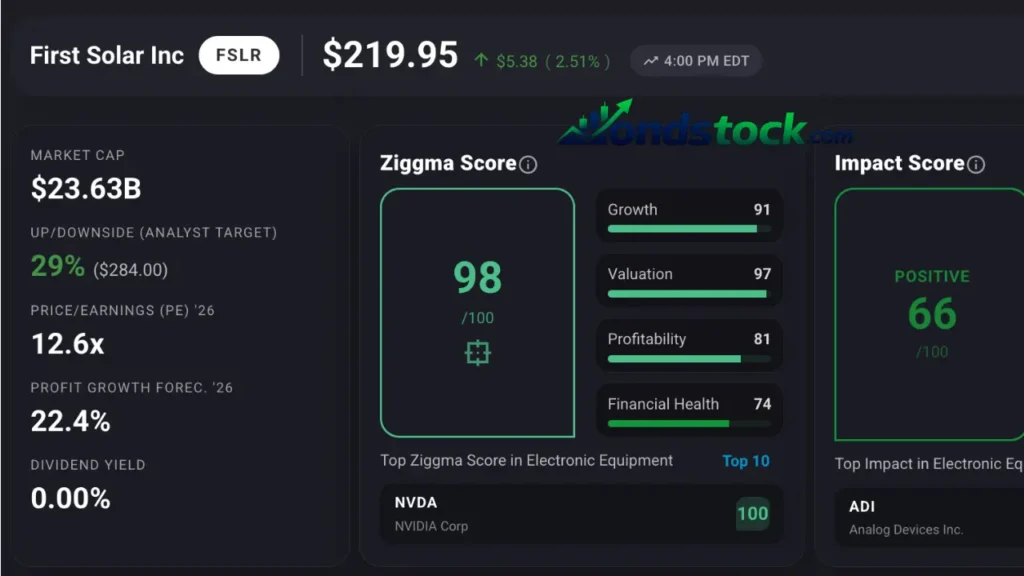
| TipRanks consensus | Moderate Buy, 21 Buys, 5 Holds, 3 Sells; average target $268.25 |
| Yahoo Finance | 1-year target estimate of $276.17 |
| Piper Sandler | Overweight, target cut to $251 from $260 |
| KeyBanc | Upgraded to Sector Weight, no price target Why First Solar Stock (FSLR) Is Plunging Today +3 |
On valuation, GuruFocus puts the P/E at 10.6x versus a five-year median of 19.8x. A low multiple on policy-supported earnings isn’t automatically cheap, because the earnings quality is the real debate.
FSLR bull, base and bear case
Bull case: Section 232 lifts module pricing, backlog converts at healthy margins, rates ease and 45X credits stay intact. The stock then re-rates toward its historical multiple, and analysts’ targets above $250 become plausible.
Base case: Earnings land near guidance, tariff and tax-credit policy stays broadly stable, and the stock trades with interest-rate sentiment. Gains are likely uneven and tied to Treasury yields.
Bear case: Congress or the administration trims solar credits, module prices stay weak, more contracts terminate, or rates keep climbing. Analysts have been cutting forecasts, and lawsuits could keep uncertainty alive for months. A securities class action over prior tariff disclosures is ongoing.
Watch next: Q3 results (typically late October; confirm the date on First Solar’s investor site), Q3 volume guidance of 3.9-4.5 GW, and the December 4 start of Section 232 enforcement.
frequently asked question
FSLR stock blog post today: where do I find the latest coverage?
For official news, use First Solar’s investor relations page and SEC filings. For market commentary, the latest developments as of late September include the 52-week low on September 24, KeyBanc’s upgrade to Sector Weight on September 28 and Piper Sandler’s target cut to $251.
FSLR stock blog post price: what is the price now?
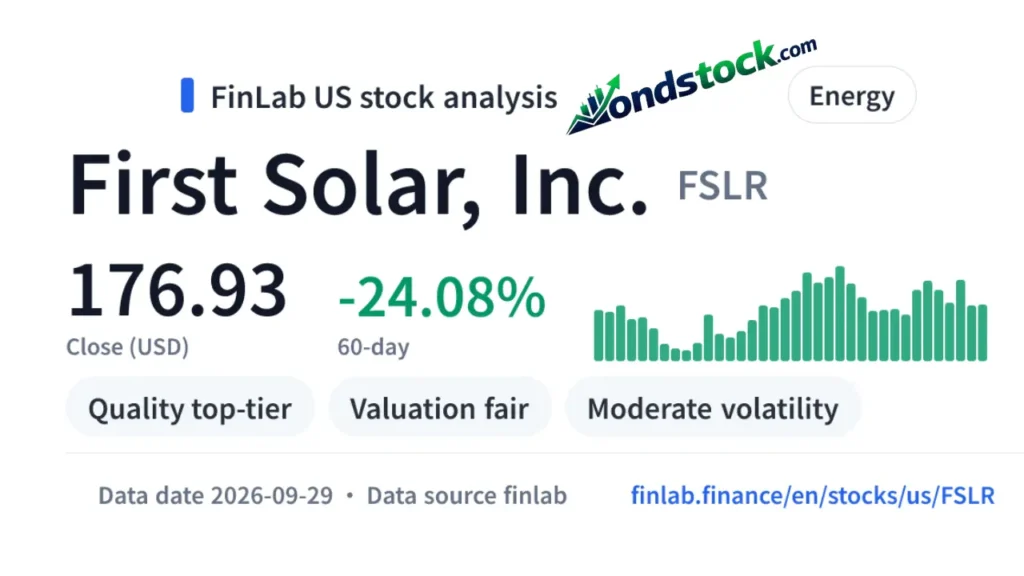
FSLR closed at $172.16 on September 24, 2026, after a 10.3% drop, and has bounced modestly since. Check a live quote, since the price changes every trading day.
What is FSLR on Stocktwits?
Stocktwits is a retail-investor social feed where traders discuss tickers like FSLR.
Is FSLR a good stock to buy?
It depends on your risk tolerance. Strengths include net cash, a 45 GW backlog and US manufacturing. Risks include reliance on Section 45X credits, rate sensitivity and pricing pressure.
What are FSLR’s latest earnings?
Q2 2026 brought $1.06 billion in sales, $3.92 diluted EPS and $644 million adjusted EBITDA. Full-year guidance was reaffirmed at $4.9-$5.2 billion in sales.
What is the First Solar stock price target?
TipRanks shows an average of about $268, and Yahoo Finance shows a 1-year estimate near $276. Individual targets vary, such as Piper Sandler’s $251.
What is the latest FSLR news?
The Section 232 polysilicon tariffs start December 4, 2026, KeyBanc upgraded the stock, and Roth called the selloff an attractive entry point.
Read More…
Top Inflation Resistant Stocks
Safest Stocks
Best Blue Chip Stocks