
The SCHD dividend calculator is useful for estimating how much dividend income you could receive from the Schwab U.S. Dividend Equity ETF based on the number of shares you own and an assumed dividend per share.
SCHD pays distributions quarterly rather than monthly. Its recent declared distributions were $0.2604 in September 2025, $0.2782 in December 2025, $0.2569 in March 2026 and $0.2525 in June 2026. That makes the latest four declared distributions total $1.048 per share.
For example, using $1.048 as a simple recent-distribution estimate:
| SCHD Shares | Estimated Annual Dividend* |
|---|---|
| 10 | $10.48 |
| 50 | $52.40 |
| 100 | $104.80 |
| 500 | $524.00 |
| 1,000 | $1,048.00 |
| 5,000 | $5,240.00 |
*This is an estimate based on the latest four declared distributions, not a guaranteed future payout.
The actual SCHD dividend amount can change from quarter to quarter, so a calculator should be treated as an estimate rather than a promise of future income.
How to SCHD Dividend Calculator Income
The basic calculation is straightforward:
Estimated annual dividend income = Number of SCHD shares × Assumed annual dividend per share
For quarterly income:
Estimated quarterly dividend = Number of shares × Assumed quarterly dividend per share
For example, if you own 500 shares and assume a $0.2525 quarterly distribution:
500 × $0.2525 = $126.25
That would be the estimated gross distribution for that quarter if the actual payout were $0.2525 per share.
For an annual estimate, you can either use the latest four distributions or multiply an assumed quarterly amount by four. Using the latest four declared SCHD distributions is generally more useful because it reflects actual recent payments rather than assuming every quarter will be identical.
SCHD Dividend Calculator Calendar 2026-2027
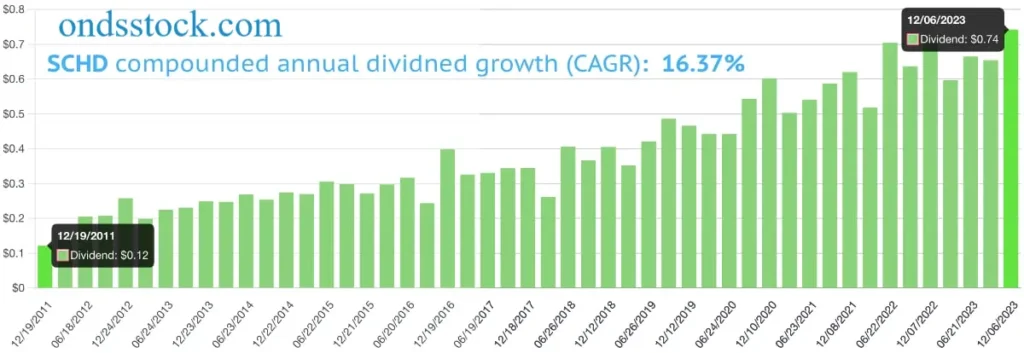
SCHD is designed to distribute income quarterly. Recent payment history shows distributions around March, June, September and December.
The current SCHD dividend calendar indicates the following upcoming dates:
| Period | Ex-Dividend Date | Payment Date | Status |
|---|---|---|---|
| Q3 2026 | September 23, 2026 | September 28, 2026 | Scheduled/forecasted |
| Q4 2026 | December 9, 2026 | December 14, 2026 | Scheduled/forecasted |
| Additional 2026 distribution | December 30, 2026 | January 5, 2027 | Scheduled/forecasted |
| Q1 2027 | March 24, 2027 | March 30, 2027 | Scheduled/forecasted |
The September 2026 and later dates above are listed by Wall Street Horizon as future SCHD distribution dates, while Schwab’s official page currently provides confirmed historical distributions through June 2026.
Because future distribution amounts can change, the calendar dates should not be confused with a guaranteed SCHD dividend amount.
SCHD Ex-Dividend Dates and Payment Schedule
The SCHD ex-dividend date is important because it determines whether a new purchaser is entitled to the upcoming distribution.
The practical distinction is:
- Ex-dividend date: The date on which shares begin trading without the upcoming distribution entitlement.
- Record date: The date used to determine eligible shareholders.
- Payment date: The date the distribution is scheduled to be paid.
- Dividend amount: The cash distribution declared per share.
For the June 2026 distribution, Schwab lists June 24 as both the ex-date and record date, with a June 29 payable date and a $0.2525 total distribution.
When Is the Next Ex-Dividend Date for SCHD?
As of September 2026, the next listed SCHD ex-dividend date is September 23, 2026, with a scheduled payment date of September 28, 2026. The amount should not be treated as final until the distribution is officially declared.
When Is the Next SCHD Dividend Payment?
The current dividend calendar lists September 28, 2026 as the next SCHD payment date following the September 23 ex-date.
How Often Does SCHD Pay Dividends?
SCHD pays quarterly dividends, meaning investors normally receive four distributions during a year.
This differs from monthly dividend ETFs, which distribute income more frequently. Quarterly payments can still be useful for income planning, but the cash-flow pattern is different.
The recent SCHD distribution history confirms the quarterly pattern:
- September 2025: $0.2604
- December 2025: $0.2782
- March 2026: $0.2569
- June 2026: $0.2525
The quarterly distribution is not necessarily the same every time. Investors using SCHD for passive income should therefore avoid assuming a fixed payment every three months.
SCHD Dividend History and Historical Performance
SCHD’s dividend history provides a better foundation for a calculator than relying on a single quarterly payment.
The latest four declared distributions total $1.048 per share:
$0.2604 + $0.2782 + $0.2569 + $0.2525 = $1.048
That means:
- 100 shares → $104.80 based on the latest four distributions
- 500 shares → $524.00
- 1,000 shares → $1,048.00
These figures are historical calculations, not forecasts.
Schwab’s official distribution history also shows that recent SCHD distributions have been classified as income, with no short-term or long-term capital-gain distribution attached to the listed 2025-2026 payments.
How Much Does SCHD Pay Per Share?
The latest confirmed SCHD distribution available from Schwab is $0.2525 per share for June 2026.
However, the SCHD dividend amount changes between quarters. Therefore, the best way to estimate annual dividend income is to use multiple recent payments rather than assuming the latest payment will repeat four times.
SCHD Annual Dividend Income Projection
Using the latest four declared distributions as a reference, the annualized recent payout is $1.048 per share.
For example:
1,000 shares × $1.048 = $1,048 estimated annual income
If distributions increase or decrease in future quarters, your actual annual payout will differ.
SCHD Dividend Yield and Payout Analysis
Dividend yield connects the annual distribution with the ETF’s market price.
The basic formula is:
Dividend yield = Annual dividend per share ÷ Share price × 100
Schwab reported SCHD’s 30-day SEC yield at 3.23% as of September 9, 2026 and its TTM distribution yield at 3.13% as of July 31, 2026. These are different measures and should not be treated as interchangeable.
For example, if an ETF’s annual distribution is $1.048 and its price is $33.98, the simple trailing distribution calculation would be approximately 3.08%. The difference from Schwab’s published distribution yield reflects differences in dates and methodology.
This is why investors should check the calculation date whenever comparing dividend yields.
SCHD Dividend Forecast for 2026-2027

A SCHD dividend forecast should be treated as an estimate rather than a guaranteed payment.
The distribution calendar currently lists:
- September 23, 2026 ex-date
- September 28, 2026 payment date
- December 9, 2026 ex-date
- December 14, 2026 payment date
- December 30, 2026 additional distribution date
- January 5, 2027 payment date
- March 24, 2027 ex-date
- March 30, 2027 payment date
Future distribution amounts are more difficult to predict than dates because they depend on the income generated by the ETF’s underlying holdings and the fund’s distribution process.
A sensible SCHD calculator should therefore allow users to enter their own assumed dividend amount instead of presenting one forecast as certain.
SCHD Dividend Reinvestment and DRIP
SCHD dividend reinvestment can turn cash distributions into additional shares.
With a DRIP, dividends are automatically used to purchase additional shares, subject to the broker’s rules.
Without reinvestment, the dividend is instead received as cash.
The Snowball Effect: DRIP vs. No DRIP
Consider an investor with 1,000 SCHD shares. If the fund distributes $0.2525 per share, the gross payment would be:
1,000 × $0.2525 = $252.50
With DRIP, that cash could be used to acquire additional SCHD shares. Those additional shares can potentially generate future distributions.
This creates a compounding effect, although the actual number of shares purchased depends on the ETF’s market price and the broker’s reinvestment process.
DRIP does not eliminate investment risk, and dividend payments themselves are not guaranteed.
SCHD Dividend Tax Considerations
The tax treatment of SCHD distributions depends on the investor’s circumstances, account type, holding period and the tax classification of the distribution.
For U.S. investors, it is important to distinguish between:
- Qualified dividends
- Non-qualified dividends
- Capital-gain distributions
- Taxable brokerage accounts
- Tax-advantaged retirement accounts
Do not assume that the entire SCHD payment will receive the same tax treatment. Your final tax reporting should be based on the tax documents supplied by your broker and fund provider.
Investors considering dividend capture strategies should also understand that buying and selling around an ex-date does not automatically create a tax advantage. Transaction costs, price movements and applicable holding-period rules can affect the outcome.
SCHD Share Price Impact on the Ex-Dividend Date
The SCHD share price can adjust around an ex-dividend date.
Conceptually, when an ETF goes ex-dividend, the value represented by the distribution leaves the fund. Market trading, however, can cause the actual price movement to differ from the distribution amount.
This is sometimes called the dividend gap.
For example, a $0.25 distribution does not mean an investor has created $0.25 of risk-free profit simply by purchasing shares before the ex-date. The market price can move for many other reasons, including broader market conditions and changes in the value of SCHD’s underlying holdings.
SCHD Dividend Capture Strategy
A SCHD dividend capture strategy generally involves buying shares before the ex-dividend date and selling afterward.
The important point is that receiving the dividend does not automatically create a profit.
An investor must consider:
- Purchase price
- Dividend received
- Price movement after the ex-date
- Trading costs
- Taxes
- Opportunity cost
- Market volatility
Because SCHD is an ETF holding many dividend-paying companies, its share price can move independently of the distribution.
For that reason, dividend capture should be analyzed as a complete trade rather than simply focusing on the dividend payment.
SCHD vs. Popular Dividend ETF Alternatives
SCHD is one option within the broader dividend ETF market. A comparison with alternatives such as VYM should consider more than headline yield.
| Factor | SCHD | VYM |
|---|---|---|
| Primary focus | U.S. dividend equities | High-dividend U.S. equities |
| Distribution frequency | Quarterly | Quarterly |
| Benchmark | Dow Jones U.S. Dividend 100 Index | FTSE High Dividend Yield Index |
| Expense ratio | 0.06% | Check current fund data |
| Best comparison points | Yield, holdings, methodology, growth, fees | Yield, holdings, methodology, growth, fees |
Schwab lists SCHD’s expense ratio at 0.060% as of August 27, 2026.
When comparing dividend-paying ETFs, investors should look at the full picture rather than selecting a fund solely because it has a higher current yield.
SCHD Dividend Health Check: What Should Investors Monitor?
Instead of asking only whether SCHD has a high dividend, monitor several indicators together.
1. Distribution consistency
Look at multiple quarters rather than a single payment.
2. Dividend growth
Historical dividend growth can provide useful context, but it does not guarantee future increases.
3. Yield
Compare the distribution yield with the ETF’s current market price and understand the measurement period.
4. Underlying holdings
SCHD’s income ultimately comes from the companies held by the ETF.
5. Expense ratio
Lower fund expenses can reduce the amount of assets consumed by operating costs. Schwab currently lists SCHD’s expense ratio at 0.06%.
6. Total return
Dividend income is only one part of an investment’s overall return. Changes in the SCHD share price also matter.
Frequently Asked Questions
Q1: What is SCHD’s record date and how does it relate to the ex-dividend date?
The record date is used to identify shareholders entitled to a distribution. For the June 2026 SCHD distribution, Schwab lists June 24 as both the ex-dividend date and record date, with a June 29 payment date.
Q2: How does Wall Street Horizon provide SCHD dividend dates so far in advance?
Wall Street Horizon says its ETF dividend calendar uses primary-sourced information and provides future distribution dates well ahead of the ex-date. Its current SCHD calendar lists several future dates extending into 2027.
Q3: Does SCHD’s share price drop on the ex-dividend date?
The ETF can experience a price adjustment around the ex-dividend date because the distribution reduces the fund’s value. However, the actual market-price movement can differ from the dividend amount because other market factors affect SCHD.
Q4: Can I set up automatic dividend reinvestment for SCHD?
Yes. Dividend reinvestment may be available through your brokerage account. The exact DRIP rules, including fractional-share treatment, depend on the broker.
Q5: What is the SCHD next ex-dividend date?
As of September 2026, the next listed SCHD ex-dividend date is September 23, 2026, with a listed payment date of September 28, 2026.
Q6: What is the SCHD dividend amount?
The latest confirmed distribution from Schwab was $0.2525 per share, with a June 24, 2026 ex-date and June 29 payment date.
Q7: How can I calculate my SCHD dividend income?
Multiply your number of shares by the assumed dividend per share. For an annual estimate, you can use the latest four declared distributions or another reasonable assumption, while remembering that future payments can change.
Q8: Does SCHD pay dividends monthly or quarterly?
SCHD pays quarterly distributions. Recent distributions occurred in March, June, September and December.
How to Use an SCHD Dividend Calculator Effectively
For a more useful estimate, enter these variables:
- Number of SCHD shares
- Assumed dividend per share
- Expected annual dividend growth
- Current SCHD share price
- DRIP: Yes or No
- Investment period
- Applicable taxes
A basic calculator can estimate income, while a more advanced model can show how reinvestment and dividend growth may affect the number of shares and future cash flow.
The key is to separate historical data, current information and future assumptions. A calculator becomes misleading when an estimated future dividend is presented as if it were already declared.
Final Takeaway
The SCHD dividend calculator is most useful when it combines the ETF’s actual distribution history with clearly labeled assumptions.
As of September 2026, SCHD’s latest confirmed distribution was $0.2525 per share, while the latest four declared distributions total $1.048 per share. Schwab reports a 3.13% TTM distribution yield as of July 31, 2026 and a 0.06% expense ratio.
The next listed SCHD ex-dividend date is September 23, 2026, with a September 28 payment date.
For investors calculating potential income, the most important variables are share count, distribution amount, reinvestment, taxes and future changes in the payout. SCHD’s historical dividend record can inform an estimate, but it cannot guarantee future distributions or investment returns.
Also Read