
Introduction
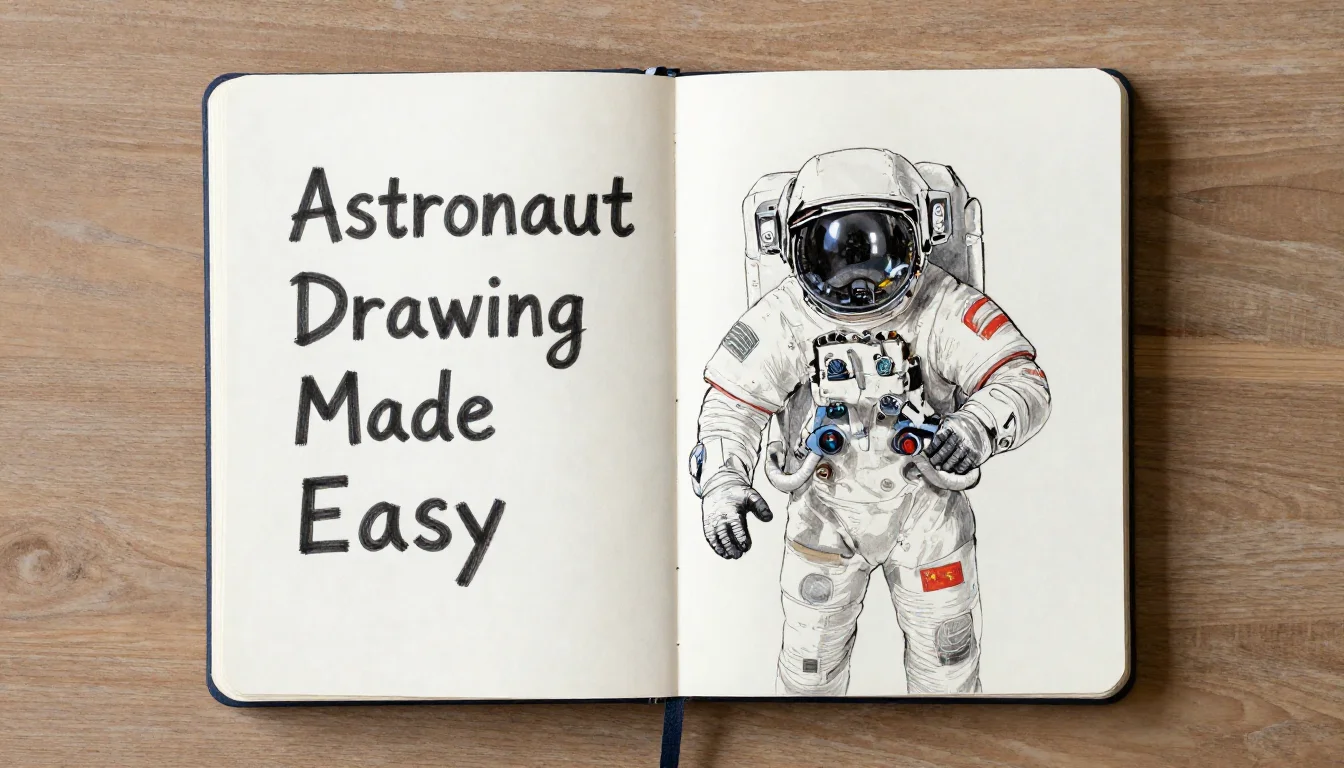
Learning how to create an Astronaut Drawing is a fun and rewarding activity for kids, beginners, students, and anyone who loves space-themed art. With just a few simple shapes and easy techniques, you can draw a realistic or cartoon astronaut without needing advanced artistic skills.
In this step-by-step guide for 2026, you’ll learn how to sketch an astronaut from start to finish, including the helmet, spacesuit, gloves, boots, backpack, and other important details. Each step is designed to be beginner-friendly, making it easy to follow whether you’re drawing with a pencil, pen, or digital tablet.
By the end of this tutorial, you’ll have a complete astronaut drawing and useful tips for adding shading, colours, and a space background to make your artwork stand out. Grab your drawing tools and let’s start creating an amazing Astronaut Drawing together.
What Makes Astronaut Drawing Unique
Astronaut drawing sits at a fascinating intersection of realism and fantasy. Unlike drawing a simple portrait or a landscape, an astronaut drawing asks you to think about several elements at once.
The Spacesuit as Your Canvas
The spacesuit is the defining feature of every astronaut drawing. It is bulky, layered, and full of interesting shapes. Tubes, visors, backpacks, patches, and gloves all add texture and detail to your work. Each piece of equipment tells a story. When you draw a spacesuit, you are not just drawing clothing — you are drawing survival technology.
The Environment Matters
Where your astronaut exists in the drawing changes everything. An astronaut drawing set on the moon feels very different from one set inside a space station or floating in deep space. The environment shapes your light source, shadows, background, and the overall mood of the piece.
Emotional Storytelling
A great astronaut drawing tells a story. Is your astronaut lonely and small against a giant planet? Are they triumphant, fist raised with the Earth behind them? Are they discovering something completely alien? The pose, expression through the visor, and surroundings all communicate emotion. That is what separates a memorable astronaut drawing from a forgettable one.
Tools You Need for Astronaut Drawing
You do not need expensive supplies to start your astronaut drawing journey. Here is what actually helps.
For Traditional Astronaut Drawing
- Pencils (HB, 2B, 4B, 6B): A range of pencils lets you control lightness and darkness. HB works well for initial sketching. Darker grades help you build depth.
- Fine-liner pens: These are perfect for inking the clean outlines of a spacesuit. The crisp lines add a comic-book quality that many astronaut drawing styles lean into.
- Blending stumps: Smooth out pencil shading to create the soft, atmospheric look of space backgrounds.
- White gel pen: This is a secret weapon for adding stars, helmet reflections, and light highlights to your astronaut drawing.
- Sketchbook with smooth paper: Smooth paper handles both pencil and ink cleanly, which is ideal for the detailed work astronaut drawing requires.
For Digital Astronaut Drawing
- Procreate (iPad): Extremely popular for digital astronaut drawing. The brush options and layering system make it beginner-friendly.
- Adobe Illustrator or Photoshop: Industry-standard tools for more advanced digital astronaut drawing.
- Clip Studio Paint: A strong alternative with great tools for linework and coloring.
- A drawing tablet: If you work on a desktop, a Wacom tablet transforms the digital astronaut drawing experience.
You do not need all of these. Start with pencil, paper, and a pen. Master the basics of astronaut drawing first. The fancy tools come later.
How to Draw an Astronaut: Step-by-Step Guide
Follow these steps and you will have a solid astronaut drawing by the end. Take your time with each stage.
Step 1: Start with Basic Shapes
Every great astronaut drawing starts with simple geometry. Sketch a large oval for the helmet. Add a wide rectangle for the torso. Use cylinders for the arms and legs. Do not worry about detail yet. You are just building the skeleton of your astronaut drawing.
The spacesuit body is wider and rounder than a normal human body. Keep that in mind as you block out your shapes. The proportions of an astronaut drawing are different from a regular figure drawing.
Step 2: Refine the Silhouette
Now that your basic shapes are down, refine the outer edge of your astronaut drawing. Soften the transitions between the helmet and the torso. Add the life support backpack behind the figure. Give the boots more weight at the bottom. The silhouette of your astronaut drawing should be immediately recognizable even without any internal detail.
Step 3: Add the Suit Details
This is where your astronaut drawing starts to come alive. Add these elements carefully:
- Visor outline with a slight reflection curve
- Shoulder rings and arm connectors
- Chest control unit or mission patches
- Glove seams and finger divisions
- Boot tread lines at the base
Work lightly at first. You can always darken lines later. Rushing through the detail phase is one of the most common reasons an astronaut drawing looks unfinished.
Step 4: Draw the Visor Reflection
The visor is the heart of any astronaut drawing. It reflects the environment around the astronaut. If your astronaut is on the moon, you might show the lunar surface and a distant Earth in the visor. If they are in deep space, show stars and a faint light source.
Use curved lines inside the visor to suggest a rounded, reflective surface. Add a bright white highlight in one corner. This small detail makes your astronaut drawing look polished and professional.
Step 5: Sketch the Background
An astronaut drawing without a background feels incomplete. Even a simple deep space backdrop with stars and a far-off planet adds enormous depth. Place your astronaut off-center for a more dynamic composition. Add a large planet or moon in the background to give scale. The contrast between the small astronaut and the enormous space around them is one of the most powerful visual tricks in astronaut drawing.
Step 6: Add Shading and Light
Decide on one main light source. For most astronaut drawings, sunlight comes from one side. Shade the opposite side of the helmet, torso, and limbs accordingly. Use gentle gradients on the white suit fabric to show roundness. Add shadow beneath the astronaut if they are standing on a surface.
Light and shadow transform a flat astronaut drawing into something three-dimensional.
Step 7: Ink or Finalize
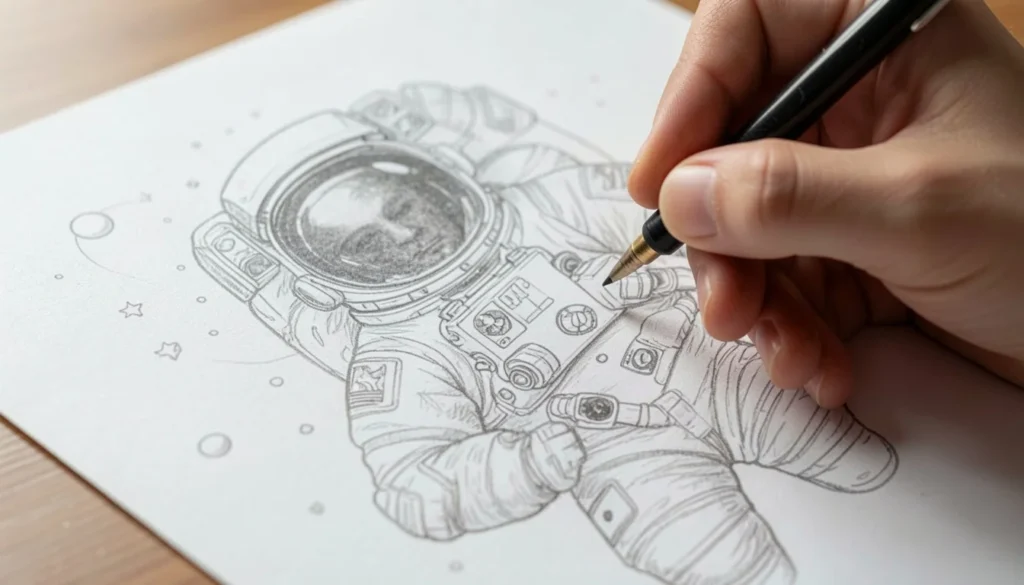
If you are working traditionally, go over your pencil lines with a fine-liner pen. Let it dry completely before erasing the pencil underneath. This step gives your astronaut drawing clean, confident lines that photograph and scan beautifully.
If you are working digitally, merge and refine your layers at this stage.
Astronaut Drawing Styles to Explore
One of the most exciting things about astronaut drawing is how many different styles suit the subject.
Realistic Astronaut Drawing
This style aims to depict the spacesuit and environment as accurately as possible. You study NASA reference photos. You get the proportions right. You nail the material texture of the suit fabric. Realistic astronaut drawing takes more time but produces deeply impressive results.
Cartoon Astronaut Drawing
Cartoon astronaut drawing simplifies shapes and exaggerates proportions. Big round helmets, stubby limbs, and expressive visors make these drawings charming and fun. This style works brilliantly for children’s content, greeting cards, and social media artwork.
Minimalist Astronaut Drawing
Less is more in minimalist astronaut drawing. Clean lines, flat color fills, and negative space do the heavy lifting. This style is extremely popular in graphic design and wall art right now.
Concept Art Astronaut Drawing
Concept art astronaut drawing takes creative liberties with suit design. You invent your own futuristic spacesuit, modify colors, add alien technology, and create an entirely original astronaut for a fictional universe. This style blends illustration with world-building.
Common Mistakes in Astronaut Drawing and How to Fix Them
Even experienced artists make these errors. Knowing them in advance saves you a lot of frustration.
Mistake 1: Making the helmet too small. The helmet in a realistic astronaut drawing is much larger than a regular human head. A pressurized suit adds bulk everywhere. Fix this by using photo reference from NASA missions.
Mistake 2: Ignoring the backpack. The Portable Life Support System sits on the back of every real spacesuit. Leaving it out makes your astronaut drawing feel incomplete or inaccurate.
Mistake 3: Flat shading on the visor. The visor is curved and reflective. Flat shading kills the illusion. Add curve-following highlight lines and a subtle reflection to make the visor in your astronaut drawing look convincing.
Mistake 4: Forgetting light from space. In space, there are no ambient light sources. Light is harsh and directional. Shadows are deep and sharp. Replicating this in your astronaut drawing creates an authentic, dramatic atmosphere.
Mistake 5: Overcrowding the background. Too many planets, stars, and effects compete with your astronaut drawing. Keep the background supportive, not dominant.
Tips to Level Up Your Astronaut Drawing Skills
Here are practical strategies that actually work.
- Study real spacesuit design. NASA’s website has thousands of high-resolution photos. Study them before you begin any astronaut drawing session.
- Draw the figure first, suit second. Sketch a basic human figure underneath your spacesuit. This keeps your astronaut drawing proportionally correct.
- Practice the visor separately. The visor is the hardest part of astronaut drawing. Spend dedicated sessions on just the visor until it feels natural.
- Use references for space environments. Photos from the Hubble Space Telescope and NASA Mars rovers give you stunning reference material for backgrounds in your astronaut drawing.
- Copy the masters. Find astronaut drawing artists you admire on Instagram or ArtStation. Study how they handle lighting and linework. Recreating their work privately teaches you faster than theory ever will.
- Commit to a daily sketch. Even a five-minute astronaut drawing each day builds muscle memory and visual vocabulary rapidly.
Astronaut Drawing for Kids vs Adults
Astronaut drawing works beautifully at every skill level and age group. The approach just changes.
Astronaut Drawing for Kids
Kids love astronaut drawing because space is inherently magical. For young learners, keep the shapes large and simple. Use bold outlines. Skip complex shading. A cartoon-style astronaut drawing with a big round helmet, simple arms, and a smiling face visible through the visor is the perfect starting point. Add colorful planets and stars in the background to make the astronaut drawing feel like an adventure.
Astronaut Drawing for Adults and Serious Learners
Adult learners often want more technical accuracy and expressive depth in their astronaut drawing. Focus on proper proportions, realistic suit textures, dramatic lighting, and storytelling through composition. Challenge yourself with difficult angles — a front-on astronaut drawing is easy; a three-quarter view or foreshortened perspective is where real growth happens.
Digital vs Traditional Astronaut Drawing
Both approaches have real advantages. Your choice depends on your goals and working style.
Traditional Astronaut Drawing
Traditional astronaut drawing — pencil, ink, and paper — builds fundamental skills faster. You cannot undo a line. That pressure makes you more deliberate and precise. Traditional astronaut drawing also produces original artwork with physical value. Many collectors specifically seek original space-themed pencil and ink pieces.
Digital Astronaut Drawing
Digital astronaut drawing gives you unlimited flexibility. You can undo, adjust colors, work in layers, and experiment without fear. The ability to zoom into fine details makes digital astronaut drawing excellent for intricate suit textures and visor reflections. Digital work is also easier to share and print in large formats.
Many artists use both. They sketch their astronaut drawing traditionally and then scan and color it digitally. This hybrid approach gives you the best of both worlds.
Where to Share and Grow with Astronaut Drawing
Creating astronaut drawing is only half the experience. Sharing it with a community accelerates your growth dramatically.
- Instagram: Use hashtags like #astonautdrawing, #spaceart, and #illustrationart to reach people who genuinely love this subject.
- ArtStation: Perfect for showcasing more polished, portfolio-quality astronaut drawing work.
- Reddit communities: Subreddits like r/learnart and r/spaceart welcome astronaut drawing enthusiasts at every level.
- DeviantArt: A long-standing platform with a dedicated community of space and sci-fi art fans.
- Pinterest: Excellent for saving astronaut drawing references and getting discovered by people searching for space art inspiration.
Getting feedback from other artists on your astronaut drawing pushes you forward far faster than working in isolation.
Conclusion
Astronaut drawing is one of the most rewarding artistic subjects you can explore. It combines human form, technical design, cosmic wonder, and emotional storytelling into a single image. Whether you are drawing a cartoon astronaut for your child, creating a realistic NASA-inspired illustration, or designing a futuristic spacesuit for a graphic novel, the core skills remain the same.
Start with simple shapes. Build your suit details with patience. Master the visor. Use strong lighting. Tell a story with your composition.
I genuinely believe that anyone who commits to practicing astronaut drawing will surprise themselves within weeks. The learning curve is real, but the creative payoff is absolutely worth it.
So grab your pencil, pull up a reference photo, and start your first astronaut drawing today. And when you finish it — no matter how rough it feels — share it somewhere. The space art community is one of the most encouraging groups of creators you will ever encounter.
What is the first type of astronaut drawing you want to try? Drop your answer in the comments below!
FAQs
Q1: How do I start an astronaut drawing as a complete beginner? Start with basic shapes: an oval for the helmet, a rectangle for the torso, and cylinders for limbs. Follow step-by-step reference guides and keep your first astronaut drawing simple. Complexity comes with practice.
Q2: What pencils are best for astronaut drawing? A set that includes HB, 2B, and 4B pencils covers all your needs. HB is great for sketching, while 2B and 4B help you build depth and shadow in your astronaut drawing.
Q3: How do I draw a spacesuit that looks realistic? Study real NASA spacesuit photos. Pay attention to the helmet size, backpack, suit joints, and surface texture. Realism in astronaut drawing comes from good reference, not guesswork.
Q4: Is astronaut drawing good for kids? Absolutely. Astronaut drawing is fantastic for children. It sparks curiosity about science and space, develops fine motor skills, and encourages creative storytelling. Keep the style simple and fun for younger artists.
Q5: What is the hardest part of astronaut drawing? Most artists find the visor the most challenging element. Getting the reflective, curved surface right takes practice. Dedicate specific sessions to drawing just the visor until it feels natural.
Q6: Can I do astronaut drawing digitally? Yes. Apps like Procreate, Clip Studio Paint, and Photoshop are all excellent for digital astronaut drawing. Digital tools give you flexibility and the ability to undo mistakes freely.
Q7: How long does it take to get good at astronaut drawing? With consistent daily practice, most people see significant improvement in their astronaut drawing within four to eight weeks. The key is drawing regularly, studying references, and seeking feedback.
Q8: Where can I find good astronaut drawing references? NASA’s official website and image gallery offer thousands of free high-resolution spacesuit photos. Pinterest and ArtStation also have huge collections of astronaut drawing art for inspiration.
Q9: What drawing style works best for astronaut drawing? It depends on your goal. Cartoon style works best for fun, accessible content. Realistic style suits portfolios and serious art projects. Minimalist style is perfect for design and wall art. All styles are valid in astronaut drawing.
Q10: Should I draw the astronaut from life or use photo reference? Always use photo reference when you are learning astronaut drawing. Real spacesuit photos give you accurate proportions, material textures, and lighting you simply cannot invent from memory.
Author Bio
Johan Harwen is a professional illustrator and art educator with over ten years of experience in character design and space-themed illustration. She has contributed tutorials to several leading art publications and runs a popular online drawing course for beginners. Sarah believes that anyone can learn to draw with the right guidance, patience, and a genuine love for the subject. When she is not creating, she is teaching, mentoring young artists, and exploring new corners of the cosmos through her sketchbook.
Also read ondsstock.com
Email: johanharwen314@gmail.com
Author Name: Johan Harwen