
Introduction
If you are researching NIO stock HK, the story has changed significantly from earlier in 2026. NIO Inc. trades on the Hong Kong Stock Exchange under ticker 9866, and its latest results show a business that is growing rapidly but still struggling to produce consistent GAAP profitability.
The stock has also become much more volatile. NIO’s Hong Kong-listed shares closed at HK$33.18 on August 31, while reports on September 1 showed the shares falling sharply after the company released its August delivery figures. The stock was reported around HK$30.14 during the session, although the price can move quickly during market hours.
At the same time, NIO’s operating numbers remain impressive. The company delivered 107,658 vehicles in Q2 2026, up 49.4% year over year, while quarterly revenue jumped 69.1% to RMB32.14 billion. However, NIO still reported a RMB528 million net loss for the quarter.
So, is NIO stock HK a buying opportunity after the recent decline, or is the weakness warning investors about deeper problems?
This updated guide covers the latest 9866 price, Q2 2026 results, delivery growth, analyst forecasts, major risks, NIO’s three brands, and what investors should watch next.
What Is NIO Stock HK?
NIO stock HK refers to NIO Inc.’s Class A ordinary shares listed on the Hong Kong Stock Exchange under ticker 9866.
NIO is also listed on the New York Stock Exchange under the ticker NIO and on the Singapore Exchange. The Hong Kong listing gives investors access to the same underlying company through the HKEX market and in Hong Kong dollars.
For investors searching for NIO 9866, NIO Hong Kong stock, or NIO stock HK price, these terms generally refer to the same Hong Kong-listed security.
The company operates three main EV brands:
- NIO: Its premium smart electric vehicle brand
- ONVO: A more mainstream brand focused on family-oriented vehicles
- FIREFLY: A compact smart EV brand aimed at the premium small-car segment
This three-brand strategy is becoming increasingly important because NIO is trying to grow beyond its traditional premium EV customer base.
NIO Stock HK Price and Key Numbers
The most recent completed Hong Kong trading session before the September 1 reaction closed NIO stock HK at HK$33.18 on August 31, 2026. The stock subsequently came under heavy selling pressure after the August delivery update.
Here are the key numbers to know:
- HKEX ticker: 9866
- August 31 closing price: HK$33.18
- 52-week range: approximately HK$32.76 to HK$61.75
- Q2 2026 revenue: RMB32.14 billion
- Q2 2026 deliveries: 107,658
- Q2 2026 net loss: RMB528 million
- Q2 vehicle margin: 18.5%
- Q2 gross margin: 18.4%
- 2026 YTD deliveries through August: 262,893
- Cumulative deliveries through August: 1,260,485
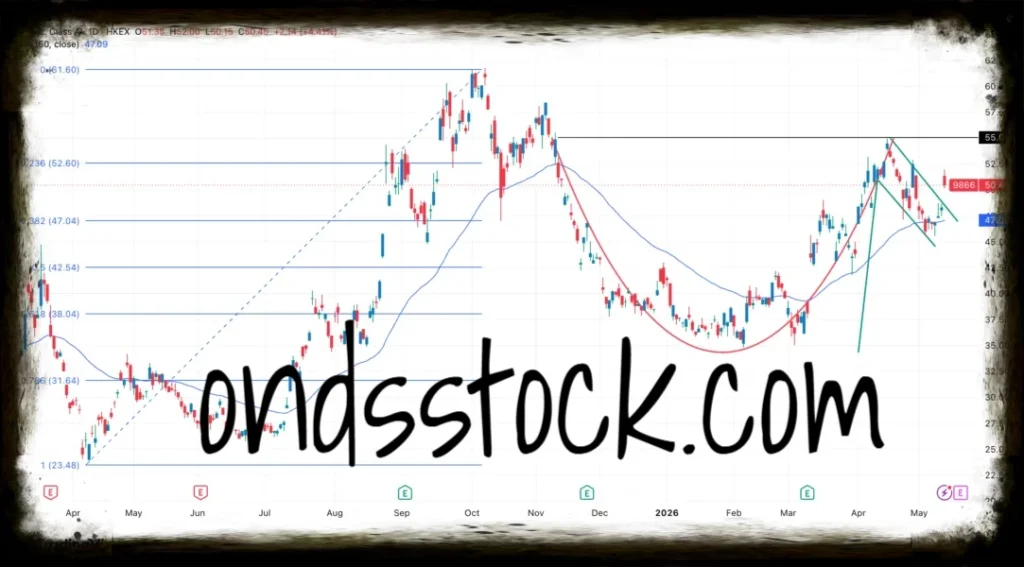
The stock’s recent decline is important because it has created a very different setup from the HK$47 area discussed in older versions of this article. Investors should therefore avoid relying on historical May 2026 price levels when evaluating NIO stock HK today.
Why Is NIO Stock HK Falling?
The immediate pressure came after NIO released its August 2026 delivery update.
NIO delivered 35,836 vehicles in August, representing a 14.5% increase from August 2025. That sounds positive, but the monthly growth rate was considerably slower than July’s 71.0% year-over-year increase.
The August deliveries included:
- 21,174 NIO vehicles
- 8,810 ONVO vehicles
- 5,852 FIREFLY vehicles
NIO’s 2026 year-to-date deliveries reached 262,893, up 57.9% year over year, while cumulative deliveries reached 1,260,485.
The market reaction suggests that investors were looking beyond the headline growth number. After a strong first half, traders are increasingly focused on whether NIO can maintain delivery momentum while improving profitability.
That makes the next few quarters especially important for the NIO stock HK outlook.
NIO Q2 2026 Earnings: What Changed?
NIO’s Q2 2026 results provide a much clearer picture of the company than the older Q4 2025 figures.
Quarterly revenue reached RMB32.14 billion, an increase of 69.1% from Q2 2025 and 25.9% from Q1 2026. Vehicle sales increased 80.1% year over year to RMB29.06 billion.
Gross profit also improved substantially.
NIO generated RMB5.91 billion in gross profit, up 211.3% from Q2 2025. Gross margin reached 18.4%, compared with only 10.0% a year earlier. Vehicle margin was 18.5%, compared with 10.3% in Q2 2025.
These figures show that NIO has made meaningful progress in unit economics.
However, the company was not yet profitable under GAAP.
NIO reported a RMB528 million net loss in Q2 2026. That was much smaller than the RMB4.995 billion loss reported in Q2 2025, but it still means the company has not established sustained GAAP profitability.
On an adjusted non-GAAP basis, NIO reported a small RMB26.1 million profit.
That distinction matters. The profitability trend is improving, but investors should not treat NIO as a consistently profitable EV manufacturer yet. Allegiant Airlines Review
NIO Stock HK Delivery Growth
Delivery growth remains one of the strongest parts of the NIO investment story.
NIO delivered 107,658 vehicles during Q2 2026, representing a 49.4% year-over-year increase and a 29.0% increase from Q1.
The quarterly breakdown was:
- NIO brand: 60,945 vehicles
- ONVO: 29,124 vehicles
- FIREFLY: 17,589 vehicles
The company continued delivering more than 35,000 vehicles per month during July and August.
July deliveries reached 35,934, up 71.0% year over year. August deliveries then came in at 35,836, up 14.5%.
The slowdown in August is one reason the market reaction was negative despite continued year-over-year growth.
For NIO stock HK investors, the key question is no longer simply whether deliveries are growing. The bigger question is whether NIO can sustain high volumes without sacrificing margins.
NIO’s Three Brands Could Drive Future Growth
NIO Brand
The core NIO brand remains focused on premium electric vehicles.
The company said the NIO brand ranked first in China’s passenger vehicle market priced above RMB350,000 during Q2. The All-New ES8 has also maintained strong momentum, reaching its 140,000th delivery within 335 days of launch.
Premium vehicles can support stronger margins, which is important as NIO works toward sustainable profitability.
ONVO
ONVO is designed to expand NIO’s reach into a broader part of the Chinese EV market.
During Q2, ONVO delivered 29,124 vehicles. NIO said the ONVO brand became the sales leader in China’s RMB200,000 to RMB300,000 large SUV segment.
If ONVO continues scaling, it could become one of the biggest contributors to NIO’s overall volume. Source: eToro
FIREFLY
FIREFLY gives NIO exposure to the premium compact EV segment.
The brand delivered 17,589 vehicles in Q2. NIO also said FIREFLY maintained the top market share in China’s high-end small-car segment for 15 consecutive months.
Together, the three brands give NIO a broader product strategy than it had several years ago.
NIO Stock HK Forecast and Analyst Targets
Analyst expectations remain relatively bullish despite the recent share-price weakness.
Recent analyst data compiled by Investing.com showed a Buy consensus for NIO’s Hong Kong-listed shares, with an average 12-month target of around HK$57.89. The reported target range extended from approximately HK$46.75 to HK$86.89.
That does not mean NIO stock HK will reach those targets.
Analyst targets are estimates, not guarantees. They can change rapidly after earnings, delivery reports, industry developments, or changes in China’s EV market.
The wide target range also tells you something important: analysts disagree about how quickly NIO can convert revenue growth into sustainable earnings.
What Could Push NIO Stock Higher?
The bullish case depends on several factors:
- Continued delivery growth
- Stable or improving vehicle margins
- Successful scaling of ONVO and FIREFLY
- Lower operating expenses
- Continued improvement in cash generation
- Stronger demand for NIO’s newer models
- Better investor sentiment toward Chinese EV stocks
If these factors come together, NIO could receive a higher valuation multiple.
What Could Push NIO Stock Lower?
The bearish case is also clear:
- Slower vehicle deliveries
- Continued GAAP losses
- Price competition in China’s EV market
- Weak demand for new models
- Higher operating or R&D costs
- Additional capital requirements
- Geopolitical and trade risks
- Weak sentiment toward Chinese equities
The recent August reaction shows how quickly investors can change their view when delivery momentum appears to slow.
NIO’s Q3 2026 Outlook
One of the most important numbers from the latest earnings report is NIO’s Q3 guidance.
Management expects third-quarter deliveries between 108,000 and 111,000 vehicles, representing year-over-year growth of approximately 24.0% to 27.5%.
That guidance suggests NIO expects another strong quarter, although the growth rate would be slower than Q2’s 49.4% year-over-year increase.
This creates an important test for NIO stock HK.
If NIO delivers near or above the upper end of its guidance while protecting margins, investor confidence could improve. If deliveries disappoint or margins weaken, the stock could remain under pressure.
NIO Stock HK vs NIO NYSE
NIO stock HK and NIO’s NYSE-listed shares represent the same underlying company.
The biggest practical differences are the exchange, currency and trading hours.
| Feature | NIO Stock HK | NIO NYSE |
|---|---|---|
| Ticker | 9866 | NIO |
| Currency | Hong Kong dollar | US dollar |
| Exchange | HKEX | NYSE |
| Main trading session | Hong Kong | US |
| Underlying company | NIO Inc. | NIO Inc. |
The two listings generally move in the same direction, although temporary differences can occur because of currency movements, market timing and investor sentiment.
For investors who already operate in the Hong Kong market, NIO stock HK can provide a more direct way to gain exposure to the company without trading the US listing. The Fool Tarot Card
Key Risks for NIO Stock HK
Chinese EV Competition
China’s EV market remains extremely competitive.
NIO competes with major companies such as BYD, XPeng and Li Auto, along with other established and emerging Chinese EV manufacturers.
Aggressive pricing can make it difficult for manufacturers to increase margins even when vehicle volumes rise.
Profitability Risk
NIO’s Q2 results showed major improvement, but the company still reported a RMB528 million net loss.
The positive adjusted profit is encouraging, but investors should watch whether GAAP profitability becomes consistent rather than relying on a single quarter of adjusted earnings.
Delivery Growth Risk
August deliveries increased only 14.5% year over year, much slower than July’s 71.0% growth.
If monthly delivery growth continues slowing, the market could begin questioning whether NIO can meet its longer-term growth expectations.
Geopolitical Risk
NIO remains exposed to the broader risks associated with Chinese companies and international trade.
Changes in tariffs, regulations, China-US relations, European EV policies or investor sentiment toward Chinese equities can affect the stock even when NIO’s own operating performance remains stable.
Dilution and Capital Risk
NIO has historically required substantial capital to fund its expansion, technology development and infrastructure.
The company reported RMB56.7 billion in cash, restricted cash, short-term investments and long-term time deposits at the end of June 2026.
That provides an important financial cushion, but investors should continue monitoring cash flow, capital expenditure and any future financing activity.
Is NIO Stock HK a Buy in 2026?
There is no simple yes or no answer.
The bull case is stronger than it was a year ago in several ways. NIO is delivering more vehicles, revenue is growing rapidly, margins have improved substantially, and its three-brand strategy is expanding its addressable market.
The bear case remains significant because NIO has not yet achieved consistent GAAP profitability and faces intense competition.
At around the low-HK$30s after the latest market reaction, valuation may look more attractive to investors who believe NIO can maintain its growth trajectory. However, a lower share price does not automatically make a stock cheap.
The most important question is whether NIO can turn its impressive revenue and delivery growth into durable profits and stronger cash generation.
For aggressive growth investors, NIO stock HK may be worth watching closely.
For conservative investors looking for stable earnings and predictable dividends, NIO remains a higher-risk choice.
What Should Investors Watch Next?
If you are tracking NIO stock HK, focus on these metrics rather than simply watching the share price:
Monthly Deliveries
Watch whether monthly deliveries stabilize above 35,000 vehicles and whether ONVO and FIREFLY continue contributing meaningful volume.
Vehicle Margin
The Q2 vehicle margin was 18.5%. Maintaining a margin around this level or improving it would strengthen the profitability argument.
GAAP Profitability
Adjusted profitability is encouraging, but the bigger milestone will be consistent GAAP net profitability.
Cash Position
NIO had RMB56.7 billion across cash, restricted cash, short-term investments and long-term time deposits at June 30. Investors should monitor how quickly that financial cushion changes.
Q3 Delivery Performance
Management expects 108,000 to 111,000 deliveries in Q3. Actual deliveries versus this range will be an important signal for NIO stock HK.
Conclusion
NIO stock HK has entered a critical phase in 2026.
The company has achieved impressive operating growth, with Q2 deliveries reaching 107,658 vehicles and quarterly revenue climbing to RMB32.14 billion. Vehicle margin also improved to 18.5%, while the net loss narrowed dramatically compared with the same quarter of 2025.
But the latest August delivery data adds a note of caution. NIO delivered 35,836 vehicles in August, up 14.5% year over year, and the stock came under significant pressure after the update.
That creates a clear investment debate.
If NIO can maintain strong deliveries, protect margins, reduce losses and eventually achieve consistent GAAP profitability, the current weakness could become an attractive opportunity for risk-tolerant investors.
If growth continues slowing while losses and competitive pressure remain high, the stock could struggle to justify bullish valuations.
For now, NIO stock HK is best viewed as a high-risk, high-potential EV growth stock rather than a safe investment. The next few quarters will reveal whether NIO’s impressive sales growth can finally translate into sustainable shareholder value.
Frequently Asked Questions About NIO Stock HK
What is the NIO stock HK ticker?
NIO trades on the Hong Kong Stock Exchange under the ticker 9866. The company is also listed on the NYSE under NIO and on the Singapore Exchange.
What is NIO stock HK?
NIO stock HK refers to NIO Inc.’s Hong Kong-listed shares traded on HKEX under ticker 9866.
What is the latest NIO stock HK price?
NIO closed at HK$33.18 on August 31, 2026. On September 1, the stock came under sharp intraday pressure following the August delivery update, with reports placing it around HK$30.14 during the session. The price changes continuously during trading.
How many vehicles did NIO deliver in Q2 2026?
NIO delivered 107,658 vehicles in Q2 2026, an increase of 49.4% year over year.
How many vehicles did NIO deliver in August 2026?
NIO delivered 35,836 vehicles in August 2026, up 14.5% year over year.
Is NIO profitable in 2026?
NIO reported a RMB528 million GAAP net loss in Q2 2026. However, adjusted non-GAAP net profit was RMB26.1 million.
What is NIO’s Q3 2026 delivery forecast?
NIO expects to deliver between 108,000 and 111,000 vehicles in Q3 2026, representing year-over-year growth of approximately 24.0% to 27.5%.
What are analysts predicting for NIO stock HK?
Recent analyst data showed a Buy consensus and an average 12-month target around HK$57.89, although analyst estimates vary widely. These targets are forecasts rather than guaranteed prices.
What brands does NIO operate?
NIO operates three major brands: NIO, ONVO and FIREFLY. Each targets a different part of the EV market.
Is NIO stock HK risky?
Yes. NIO stock HK carries significant risks, including intense Chinese EV competition, ongoing GAAP losses, delivery volatility, geopolitical uncertainty and potential capital requirements.
Is NIO stock HK worth watching in 2026?
Yes, particularly if you are comfortable with high volatility. The combination of strong delivery growth, improving margins and a narrowing loss makes NIO an important EV stock to monitor, but profitability remains the key unresolved issue.
ondsstock
About the Author
Johan Harwen is a financial markets writer with over eight years of experience covering Asian equity markets, emerging technology stocks, and the global electric vehicle industry. He has written for leading investment publications and specializes in helping everyday investors make sense of complex growth stories. When he is not analyzing stock charts, he follows EV industry developments across China, Europe, and North America closely.
Also read ondsstock.com
Email: johanharwen314@gmail.com
Author Name: Johan Harwen